|

|
Math 121 - Calculus for Biology I
Spring Semester, 2004
Product Rule
|
|
|
|
© 2001, All Rights Reserved, SDSU
& Joseph M. Mahaffy
San Diego State University -- This page last updated 04-Jan-04
|
|

Product Rule
- Gompertz Model for Tumor Growth
- Product Rule
- Worked Examples
- Ricker's Growth Function
- References
Gompertz Model for
Tumor Growth
- Tumors grow based on the nutrient supply available
- Tumor angiogenesis is the proliferation of blood vessels
that penetrate into the tumor to supply nutrients and oxygen and to remove
waste products
- The center of the tumor largely consists of dead cells,
called the necrotic center of the tumor
- The tumor grows outward in roughly a spherical shell shape
- Simpson-Herren and Lloyd (1970)
studied the growth of tumors
- They studied the C3H Mouse Mammary tumor
- Ttritiated thymidine was used to measure the cell cycles
- This gave the growth rate for these tumors
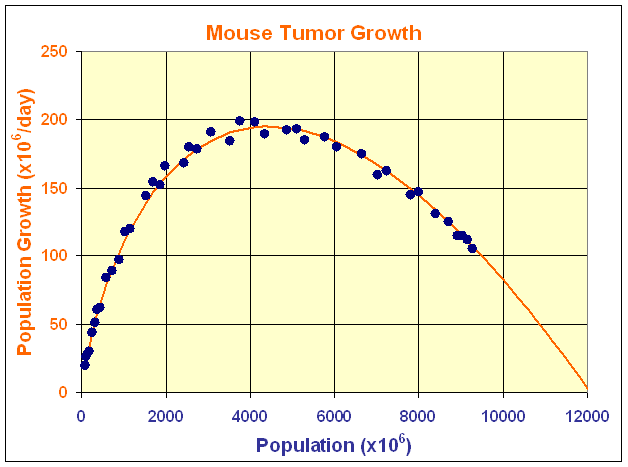
- Below is a graph showing the population of tumor cells and
the growth rate of the tumor at the various sizes of the tumor
- The graph includes the curve for the Gompertz model
- Laird (1964) showed that tumor
growth satisfies Gompertz growth equations
G(N)
= N(b - a ln(N))
- Where N are the
number of tumor cells and a and
b are constants matched to the
data
- This function is not defined for N
= 0
- For the data above, the best fit curve is
G(N)
= N(0.4126 - 0.0439 ln(N))
- The growth of the tumor stops at equilibrium
- The tumor is at its maximum size supportable with the available
nutrient supply
- We also want to know when the tumor is growing most rapidly
- This occurs when the derivative is zero
G(N)
= N(b - a ln(N)) = 0
- Since N > 0,
this occurs when b - a ln(N)
= 0
ln(N) = b/a
Ne = eb/a
- Thus, Ne = eb/a
is the unique equilibrium (carrying capacity)
- For the specific data above, the
Ne
= e0.4126/0.0439 =
= e9.399 = 12,072
- Which matches the P-intercept
on the graph above
- Finding the derivative of G(N)
presents a new problem in differentiation
- We need the product rule for differentiation to differentiate
G(N)
Product Rule
- Let f(x) and g(x) be differentiable functions.
The product rule for finding the derivative
of the product of these two functions is given by:

- In words, this says that the derivative of the product of
two functions is the first function times the derivative of the second function
plus the second function times the derivative of the first function
Example 1:
Consider f(x) = x5
- We know that f
'(x) = 5x4
- Let f1(x) = x2 and
f2(x) = x3, then f(x) = f1(x) f2(x)
- From the product rule we have
f
'(x) = f1(x) f2'(x) + f1'(x) f2(x) = x2(3x2) + (2x)x3 =
5x4
Maximum Growth for the Gompertz Tumor Growth
Model
- Apply the Product Rule to the Gompertz Growth function
G(N)
= N(b - a ln(N)),
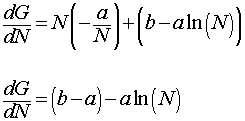
- The maximum occurs when G '(N)
= 0,
a
ln(Nmax) = b - a.
Nmax = e(b/a
- 1).
- Applied to the Gompertz model for the mouse mammary tumor,
then the maximum occurs at the population
Nmax
= e(9.399 - 1) = 4,441 (x106).
- Substituted into the Gompertz growth function, the maximum
growth of mouse mammary tumor cells is
G(Nmax)
= 4441(0.4126 - 0.0439 ln(4441)) = 195.0 (x106/day).
Example 2:
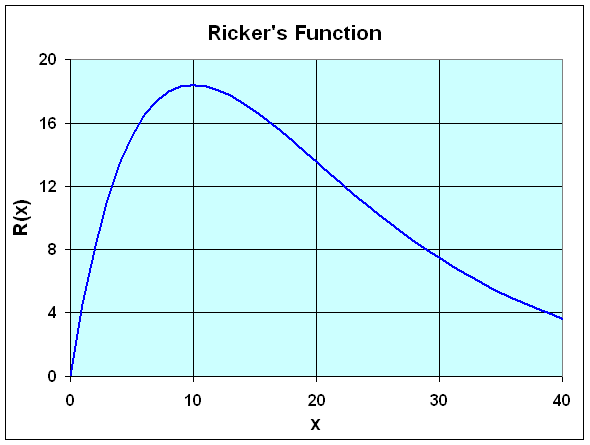
Consider the Ricker function R(x) = 5x e-0.1x
- Sketch a graph of this function, finding all extrema and
points of inflection
Solution:
The only intercept is the origin, (0,
0)
R '(x) = 5x
(-0.1 e-0.1x) + 5 e-0.1x = 5 e-0.1x(1 - 0.1x)
- Since the exponential function is never zero, R
'(x) = 0
implies that the only critical point satisfies
1 - 0.1x
= 0 or
x = 10
- There is a maximum at (10,
50 e-1) or (10,
18.4)
- Next the second derivative or the derivative of R '(x) gives
R ''(x) = 5 e-0.1x(- 0.1) + 5(- 0.1) e-0.1x(1 - 0.1x)
= 0.5 e-0.1x(0.1x - 2)
- The point of inflection is found by solving R
''(x) = 0
- The point of inflection occurs at x
= 20
(20, 100 e-2) or (20,
13.5)
Worked Examples
References
[1] A. K. Laird (1964), Dynamics of tumor growth, Brit.
J. Cancer 18, 490-502.
[2] L. Simpson-Herren and H. H. Lloyd (1970), Kinetic parameters
and growth curves for experimental tumor systems, Cancer Chemother. Rep.
Part I, 54, 143-174.