|

|
Math 121 - Calculus for Biology I
Spring Semester, 2009
Other Functions and Asymptotes
|
|
|
|
© 2001, All Rights Reserved, SDSU & Joseph
M. Mahaffy
San Diego State University -- This page last updated
16-Feb-09
|
|
Other Functions and Asymptotes
- Michaelis-Menten Enzyme
Kinetics
- Polynomials and Rational
Functions
- Worked Examples
- Acid Chemistry Revisited
- Square Root Function
- References
Michaelis-Menten
Enzyme Kinetics
- Life forms are characterized by their distinct molecular
composition, especially proteins
- Proteins are the primary building blocks of life
- Enzymes are proteins that facilitate reactions inside the
cell
- Enzymes are noted for their specificity and speed under
a narrow range of conditions
- b-galactosidase catalyzes
the break down of lactose into glucose and galactose
- Urease rapidly converts urea into ammonia and carbon
dioxide
- The simplest enzyme reaction follows the Michaelis-Menten
mechanism
- Substrate, S, combines reversibly
to the enzyme E to form a enzyme-substrate complex
ES
- The complex decomposes irreversibly to form a product P
- The reaction is written as follows:

- The law of mass action is applied to these biochemical equations
- Differential equations are formed, which will be introduced
later in the semester
- Simplifications allow easier understanding of the basic
reactions
- The enzyme-substrate complex forms extremely rapidly,
creating a quasi-steady state
- The forward reaction or turnover
number, k2,
occurs on a slower time scale
- The Michaelis-Menten reaction rate of the forward reaction
to the product satisfies
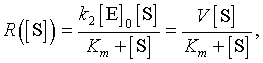
- where [S] is the substrate concentration and V
and Km are kinetic
constants determined by the reaction given above
- The constant V (or Vmax)
is called the maximal velocity of the reaction
- Km is the
Michaelis constant, and its value is the value of the substrate concentration
at which the reaction achieves half of the maximum velocity
- Note that the function R
is a rational function.
Binding of ATP to Myosin
- Pate [1] shows that binding of ATP to myosin in
forming cross-link bridges to actin for the power stroke of striated muscle
tissue satisfies a Michaelis-Menten kinetics
- The reaction velocity is an actual velocity of motion, where
the chemical energy of ATP is transformed into mechanical energy by movement
of the actin filement
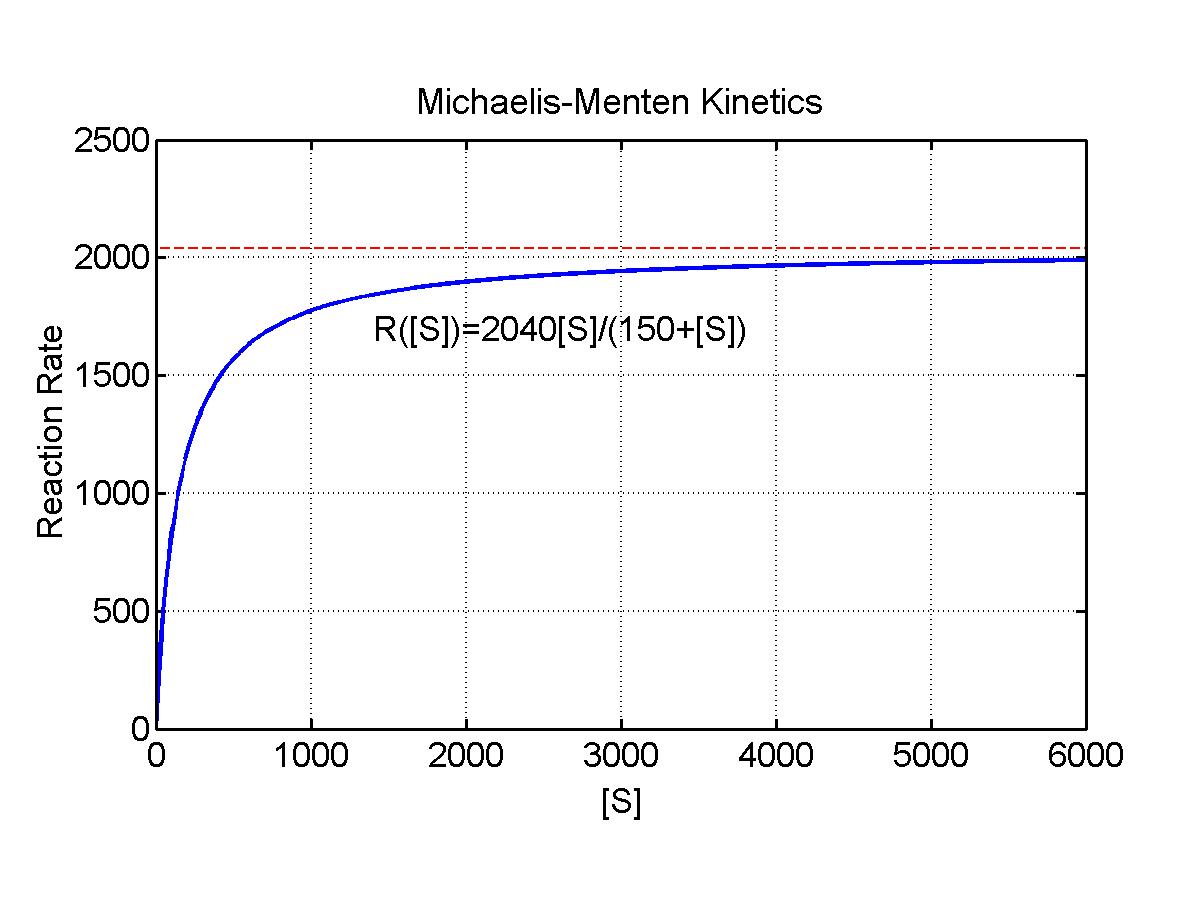
- For rabbit psoas muscle tissue, experimental measurements
give Vmax = 2040 nm/sec and
Km = 150 mM
- The applet below shows how the reaction rate R
varies as a function of [S] = [ATP]
for various values of the maximal velocity V
and the Michaelis constant Km
- There is an initial rise in the reaction velocity, which
is almost linear
- As the concentration increases, there are diminishing returns
with the eventual saturation of the reaction at some maximal rate
- The Worked Examples
section shows how a change of variables allows the conversion of this problem
into a linear problem, the Lineweaver-Burk plot.
Alternate link
Polynomials
and Rational Functions
- The most general polynomial
of order n
is written:
pn(x) = anxn
+ an-1xn-1 + an-2xn-2
+ ... + a1x + a0,
where the coefficients ai
are constants and n is a positive integer
- Linear functions are first order polynomials
- Quadratic functions are second order polynomials
- Polynomials are used to fit complicated data, providing
a simple model
- Excellent routines exist for finding the best least squares
fit of a polynomial to data
- Polynomials are defined for all values of x
and form very smooth curves
- It easy to use polynomials for interpreting data
- Finding where minimum
and maximum values occur
- Computing the area under the
curve
- These phenomena are topics that Calculus
covers
- Polynomials are considered nice
functions because of their well-behaved properties
- Difficult to find the roots of an equation (setting pn(x)
= 0) for a polynomial with n > 2,
and rarely even possible for n > 4
Example:
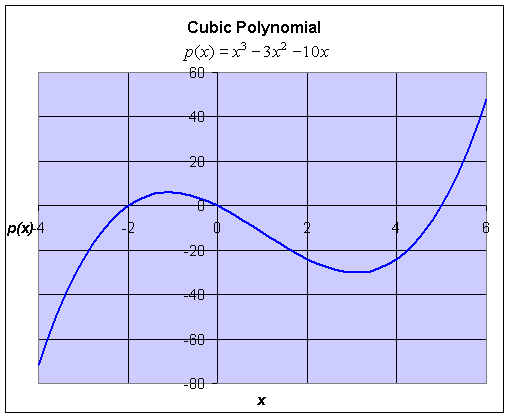
Consider the cubic polynomial given by
p(x)
= x3 - 3x2 - 10x.
Find the roots of this equation and graph this cubic polynomial.
Solution:
- Must find a factorization in order to find the roots of
this polynomial (since n > 2).
p(x) = x3 -
3x2 - 10x = x(x - 5)(x + 2) = 0.
- The roots of this polynomial are x
= 0, -2, or 5
- Later techniques of Calculus will find the high point occurring
at (-1.08, 6.04) and the low point occurring
at (3.08, -30.04).
Rational functions
are the quotient of two polynomials.
- A function r(x)
is a rational function if p(x)
and q(x) are polynomials and r(x)
= p(x)/q(x)
- The domain of the rational function,
r(x), is
all x such
that q(x) does
not equal zero
- The roots of the polynomial q(x)
are candidates for vertical asymptotes
of r(x)
- When the order of the polynomial in the numerator of a rational
function is less than or equal to the order of the polynomial of the denominator,
then a horizontal asymptote occur
- Commonly occur in biological appications
- For Michaelis- Menten kinetics, the reaction rate satisfies
R([S]) as the quotient of the
linear functions p([S]) = V[S]
and q([S]) = Km + [S]
Asymptotes: Vertical and horizontal asymptotes are very important for determining the shape of a graph.
Vertical Asymptote: When the graph of a function f(x) approaches a vertical line, x = a, as x approaches a, then that line is called a vertical asymptote.
Horizontal Asymptote: When the graph of a function f(x) approaches a horizontal line, y = c, as x becomes very large (either positve or negative), then that line, y = c, is called a horizontal asymptote.
Let r(x) = p(x)/q(x) be a rational function with polynomials p(x) = anxn + ... + a0 of degree n in the numerator and q(x) = bmxm + ... + b0 of degree m in the demoninator.
- If n < m, then r(x) has a horizontal asymptote of y = 0.
- If n > m, then r(x) becomes unbounded for large values of x (positve or negative).
- If n = m, then r(x) has a horizontal asymptote of y = an/bn.
Example:
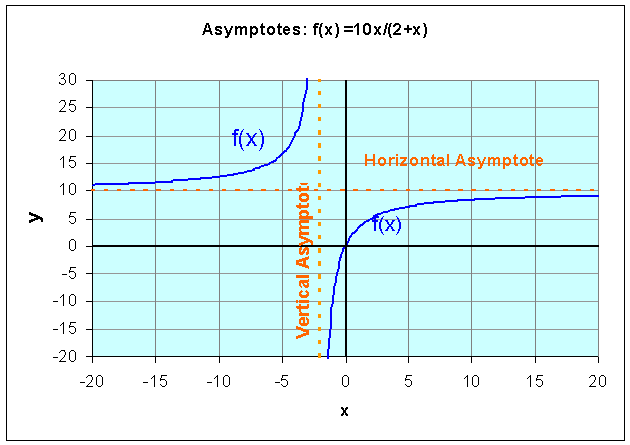
Let us examine the rational function
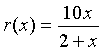
Find the domain of this function, the x
and y-intercepts, and vertical and horizontal
asymptotes, then sketch a graph of the function.
Solution:
- The domain of this function must exclude x
= -2
- Since r(0) = 0 and 10x/(2+x)
= 0 implies that x = 0, the x
and y-intercepts are easily seen to be
zero. Thus, this function passes through the origin
- As x gets close to -2,
the function becomes undefined and the value of r(x)
goes to either positive or negative infinity. Thus, x
= -2 becomes a vertical asymptote.
- For large values of x,
r(x) approaches 10x/x
= 10. This becomes the horizontal asymptote
A hyperlink is provided to Worked
Examples to show you how to work with rational functions.
Acid
Chemistry Revisited
From before, the concentration of the acid, [H+],
for a weak acid uses the quadratic formula. The concentration of acid depends
on the equilibrium constant and the normality, x,
of the weak acid solution.

Since the equilibrium constant is fixed depending on the particular
weak acid, we see that the [H+] is a function of the normality
of the solution, x, and it is a square root
function.
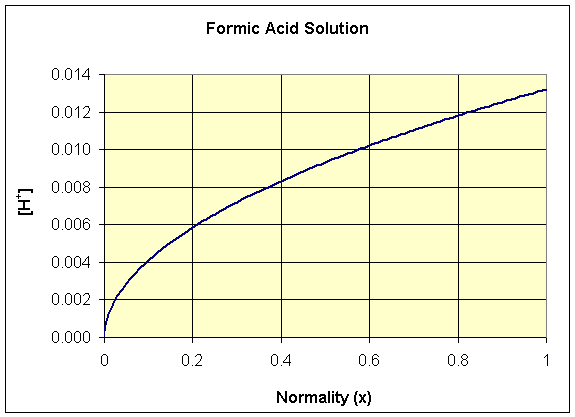
Below is a graph of the [H+] as a function
of x for formic acid, where Ka
= 1.77×10⁻⁴. Note that this function has the shape of
a quadratic function rotated 90o.
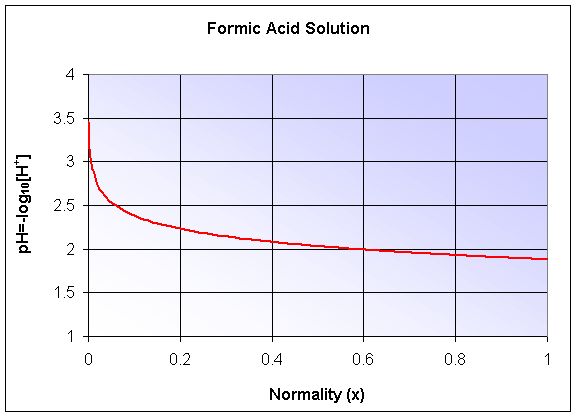
The pH of the solution is -log10([H+]),
which becomes a composite function. Logarithms are studied in the next section.
Square
Root Function
- The square root function is the inverse of the quadratic
function
- The square root function is only defined for positive quantities
under the radical
- The domain of a square root function
is found by solving the inequality for the function under the radical being
greater than zero
Example:
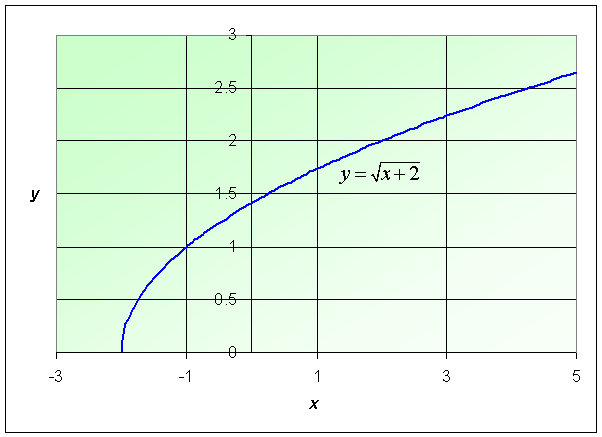
Consider the function

Find the domain of this function and graph the function.
Solution: The
domain of this function satisfies x + 2 >
0 or x > -2.
See the Worked Examples
section for more information on square root functions.
References:
[1] E. Pate (1997), "Modeling of muscle crossbridge
mechanics," in Case studies in Mathematical Modeling - Ecology, Physiology,
and Cell Biology, eds. H. G. Othmer, F. R. Adler, M. A. Lewis, and J. C.
Dallon, Prentice-Hall.