|
|
Math 121 - Calculus for Biology I |
|
|---|---|---|
|
San Diego State University -- This page last updated 08-Jan-03 |

Other Functions and Asymptotes: Examples
|
|
Math 121 - Calculus for Biology I |
|
|---|---|---|
|
San Diego State University -- This page last updated 08-Jan-03 |
Example 1: Let us solve the following equation:
Solution: We factor this equation into the following:
Thus, the solution is given by x = -2, -1, 1, and 2.
Example 2: Let us solve the following equation:
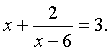
Solution: Provided x is not 6, we can multiply through by x - 6 giving:

Thus, x = 4 or 5.
Example 3: Consider the function

Find the domain of the function and the x and y-intercepts. Determine any vertical or horizontal asymptotes. Sketch the graph of this function.
Solution:


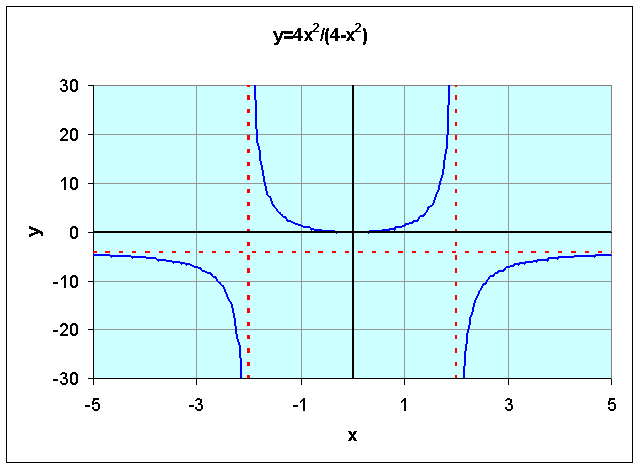
Example 4: Consider the function

Find the domain of the function. Determine any vertical or horizontal asymptotes. Sketch the graph of this function.
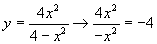
Solution:
x = ±2
Example (Lineweaver-Burk Plot): The Michaelis-Menten rate function traces out a hyperbola with the velocity function as

The inverse of this expression is

Let y = 1/V and x = 1/[S], then
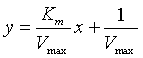
The slope of this line is Km/Vmax, the y-intercept is 1/Vmax, and the x-intercept is -1/Km. Below is a graph of this straight line, the Lineweaver-Burk plot.

Thus, by graphing 1/V versus1/[S], with data on an enzyme (forming a line), the Lineweaver-Burk allows easy identification of the Michaelis-Menten constant Km and the maximum velocity Vmax.
Example 5: Suppose an enzyme satisfies the equation
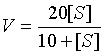
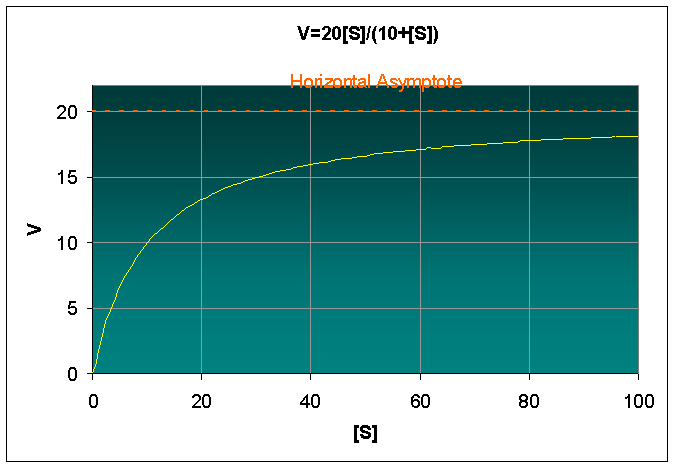
a. Sketch a graph of this function for 0 < [S] < 100. Find any horizontal asymptotes.
b. Determine the linear equation for x = 1/[S] and y = 1/V, then create the Lineweaver-Burk plot. Find the intercepts on the x and y axes. What is the slope for this line?
Solution:
a.
b. For x = 1/[S] and y = 1/V, we have [S] = 1/x and V = 1/y. Substituting these into the given equation, and solving for y, we obtain

or

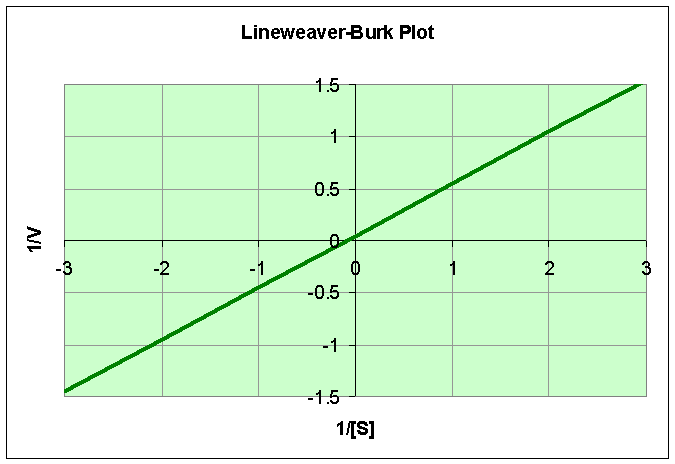
The slope of this line is 1/2, and the y-intercept is 1/20. The x-intercept is found by setting y = 0, and solving for x. Therefore, the x-intercept is equal to -1/10.
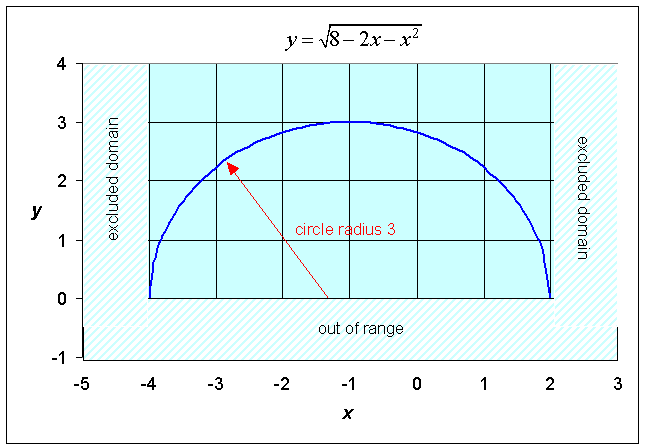
Example 6: Consider the following functions with square roots. Find the domains and ranges of these functions, then sketch their graphs.

Solution:
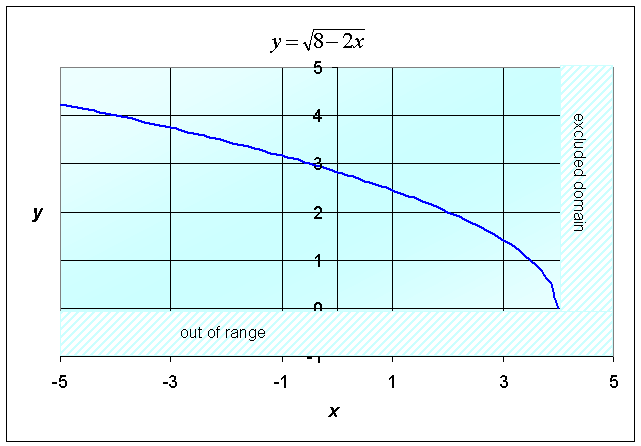
a. The quantity under the square root sign must be positive, so to find the domain we must first solve
Thus, the domain is x < 4. The range can be seen from the graph below and satisfies y > 0.
b. The quantity under the square root sign must be positive.
8 - 2x - x2 > 0
8 - 2x - x2 = (4 + x)(2 - x) = 0
or
x = -4 and 2
for the boundary of the domain