Discrete Malthusian growth models
are linear models
A constant growth rate times the dependent discrete
variable, Pn
A time varying growth rate times the dependent discrete
variable, Pn
This section examines a model for breathing and population
models that include either immigration or emigration
These models are linear, but include a constant term
Begin the study of qualitative analysis of these models
Lung Diseases and Modeling Breathing
Pulmonary ventilation
or breathing brings oxygen to the cells of the body and removes metabolic
waste product, carbon dioxide.
Inspiration
or inflow of fresh air results from the contracting the muscles of the diaphragm
Relaxation of these muscles or contraction of the abdominals
causes expiration
of air with the waste product CO2
Normal respiration in
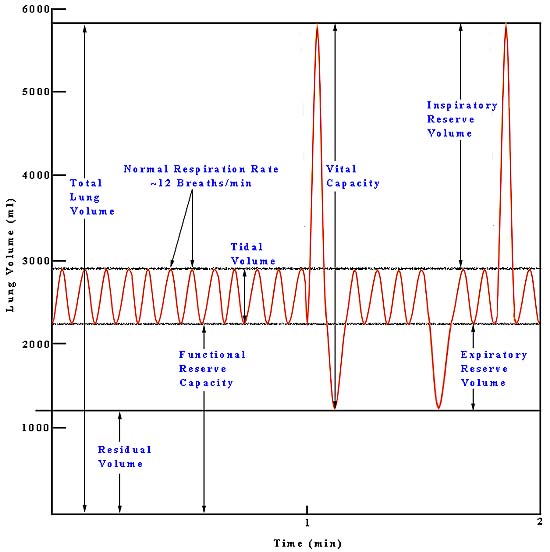
the lungs exchanges about 500 ml of air 12 times a minute
Tidal volume is
the normal volume of air inspired or expired
The inspiratory reserve volume
is about 3000 ml that can be inspired above the tidal volume
The expiratory reserve volume
is about 1100 ml, which can be forcefully expired
The vital capacity
includes all of the above yielding about 4600 ml
Well-trained athletes may have values 30-40%
higher
Females generally have 20-25% less
for the quantities listed above
The lungs contain surfactants, which prevent them from totally
collapsing
Expelling all air requires too much energy to reinflate
them from the collapsed state
Premature babies born before their genes for producing
surfactants have turned on use more energy to breath than they derive
from the process of breathing
Theresidual volume
is the amount of air that cannot be expelled and averages about 1200 ml
The functional
residual capacity is the amount of air that remains
behind during normal breathing, which amounts to 2300 ml
The body depends on an adequate supply of oxygen to the
tissues, which depends on respiration through the lungs.
Several respiratory diseases jeopardize the vital function
of the lungs.
The respiratory muscles damaged by spinal paralysis
or poliomyelitis decreases the vital capacity to as low as 500 ml
The pulmonary compliance reduces vital capacity in diseases
like tuberculosis, emphysema, chronic asthma, lung cancer, chronic bronchitis,
cystic fibrosis, or fibrotic pleurisy.
Several of the diseases above and heart disease can
cause pulmonary edema, decreasing vital capacity from fluid build up
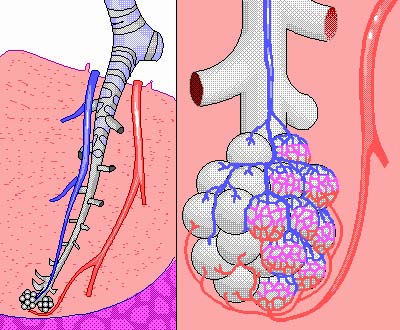
The alveoli are where the oxygen actually enters the blood
When the alveoli are damaged or filled with fluid (one result
of smoking), the exchange of oxygen is inhibited
The vital capacity and residual volume help physiologists
determine the health of the pulmonary system
The vital capacity is easily measured by taking a deep breath
and expiring into a spirometer
Some of the diseases, like emphysema, are determined by
the tidal volume and the functional residual capacity, the average or minute
respiratory volume
When the ratio of the tidal volume to the functional residual
capacity becomes too low, then there is insufficient exchange of air to maintain
adequate supplies of oxygen to the body
Discrete Model for Breathing
Tidal volume and the functional residual capacity is found
by breathing a mixture including an inert gas
The subject breathes the mixture until the lungs are
essentially filled with this mixture
A physiologist measures the amount of the inert gas
in a series of breaths after the subject is removed from the gas mixture
to normal air
The mathematical model for this experiment is a discrete
dynamical system
Professor Bruce Wingerd ran dilution experiments with the
inert gas argon (Ar)
Argon is a noble gas, so is totally non-reactive
It is the third most common gas, comprising 0.93% of Earth's
atmosphere (dry air has Nitrogen, N2, 78%, Oxygen, O2,
21%, with CO2 a distant fourth, 0.03%)
The subjects breathe an air mixture with 10% Ar
Then the subjects resume breathing normal air at a normal
rate
Below are tables that show the percent of Ar in each of
the next six breaths along with the tidal volume is given by the average volume
in each breath.
Normal Subject
Tidal Volume = 550 ml
Subject with Emphysema
Tidal Volume = 250 ml
Breath
Number
Percent
Ar
0
0.100
1
0.084
2
0.070
3
0.059
4
0.050
5
0.043
6
0.037
Breath
Number
Percent
Ar
0
0.100
1
0.088
2
0.078
3
0.069
4
0.061
5
0.055
6
0.049
Use these data to determine the functional reserve volume
for our subjects
Determine the vital capacity using a spirometer
A physiologist uses this information to find the health
of a subject's lungs.
This breathing experiment is a dynamic exchange of gases,
which occurs at discrete intervals of time
Suggests a discrete dynamical model tracking the concentration
of Ar in the lungs
Define the concentration of Ar at the end of the nth
inspiration cycle as cn
The concentration at the end of the (n + 1)st inspiration cycle depends on remaining
air in the lungs from the previous cycle and inhaling fresh air from the atmosphere
Assume the gases become well-mixed during this process,
which ignores some of the complications caused by the actual physiological
structures in the lungs, such as the "anatomical dead space" in the pharynx,
trachea, and larger bronchi or weak mixing from slow gas flow in the alveoli
In fact, of the 500 ml of fresh air brought in by inspiration,
only about 350 ml reaches the alveoli, which means that there is less
than a seventh exchange of gases with a normal breath
The physiological parameters for this model
Vi for the
tidal volume (air normally inhaled and exhaled)
Vr for the
functional residual volume
g for the concentration of Ar in the atmosphere
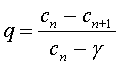
Let q = Vi/(Vi + Vr) be the fraction
of atmospheric air exchanged in each breath
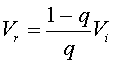
Thus, Vr/(Vi + Vr) = (1 - q) is the residual air fraction
Upon exhaling, there remains behind the functional residual
volume with the amount of Ar given by Vr
cn
The inhaled air during this cycle contains the amount of
Ar given by Vi g
Quantities or amounts of Ar are given by the volume times
concentration
The amount of Ar in the next breath is given by
Vr cn + Vi
g
The concentration of Ar is found by dividing by the total
volume, Vi + Vr
The model becomes
cn+1 = Vrcn/(Vi + Vr) + Vig/(Vi + Vr)
Use the value of q to produce the linear discrete dynamical model for
breathing
Linear Discrete Dynamical Model
for Breathing an Inert Gas
cn+1 = (1 - q)
cn + q
g
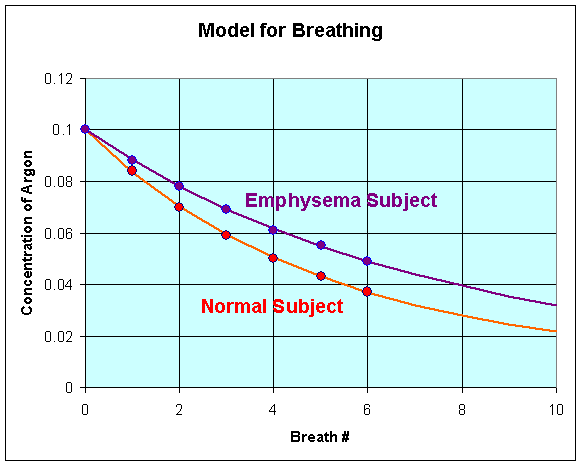
Below is a graph of the data above with the best
fitting model for breathing
Finding the Functional Reserve Capacity
The object of the experiments was to find the functional
reserve capacity
The diseased states are often characterized by a decreased
ratio between the tidal volume and the functional reserve capacity
Emphysema is characterized by a loss of elasticity in the
lungs and a decrease in the alveolar surface/volume ratio
The discrete dynamical model for breathing an inert gas
is solved for the parameter q
From the data for the normal subject, q = (0.1 - 0.084)/(0.1 - 0.0093)
= 0.18
The volume of the functional reserve capacity, Vr , satisfies
From the data above, Vr
= 0.82(550)/0.18 = 2500 ml
The ratio of the tidal volume to the functional reserve
capacity is 0.22
A similar analysis of the subject with emphysema gives q = (0.1 - 0.088)/(0.1 - 0.0093)
= 0.13
The functional reserve capacity for the subject with emphysema
is Vr
= 0.87(250)/0.13 = 1670 ml
The ratio of the tidal volume to the functional reserve
capacity is 0.15, significantly smaller than
the one for the normal subject
Equilibrium and Cobwebbing
The discrete dynamical model for breathing shows the concentration
of Ar decreasing
If the simulation for the normal individual is carried out
for about 3 minutes or 36 breaths, it can be seen that the concentration of
Ar drops to 0.0094, which is within 1% of the atmospheric concentration
Since Ar is an inert gas, we expect that after breathing
an enriched source of Ar, then the concentration should return to the same
value as normally found in the atmosphere
This value is the equilibrium value of Ar for the model
Consider a discrete dynamical system given by the equation
xn+1 = f(xn),
where f(xn) is any function
describing the dynamics of the model
An equilibrium, xe,for this
discrete dynamical system is achieved if xn+1 = xn = xe
The dynamic variable settles into a constant value for all
n.
The mathematical model for breathing should reach an equilibrium
value that corresponds the the value of Ar in the atmosphere
Let cn+1 = ce and cn = ce
The discrete dynamical model for breathing becomes
ce = (1
- q)
ce + q
g,
This is easily solved and gives ce = g, as expected
Cobwebbing
Graphic depiction of discrete dynamical models
The general model above states that xn+1 = f(xn)
The (n + 1)st state of the model, xn+1, is a function depending on the nth
state of the model, xn
Graph with the variable xn+1 on the vertical axis and xn on the horizontal
axis
Draw the graph of xn+1 = f(xn) and the line
xn+1 = xn
A process called cobwebbing allows
us to view the dynamics of this discrete dynamical model
Start at some point x0 on the horizontal
axis, then go vertically to f(x0) to find x1
Next go horizontally until we hit the line xn+1 = xn
From here go vertically to f(x1) to find x2
The process is repeated to give a geometric view of the
discrete dynamical model
At any point where the function f(xn) crosses the line
xn+1 = xn, there is an equilibrium for the model
The cobwebbing technique is illustrated with the discrete
dynamical model for breathing
Below is a graph showing the simulation for the normal subject
listed in the table above
Notice that for the breathing model, the concentration,
cn, tends towards the equilibrium concentration,
ce = g
When the solution approaches the equilibrium for large n,
then the equilibrium is said to be stable
Malthusian
Growth Models with Immigration or Emigration
In the previous section, we examined the discrete Malthusian
growth model for the U. S. population
A simple Malthusian growth model has a limited value for
studying the U. S. population though the nonautonomous Malthusian growth model
substantially improved our predictions
These models only account for the net growth of the population
in what is considered a closed system,
since it acts as if the population is totally dependent on the population
being studied
Throughout U. S. history, our population has been significantly
affected by the rate of immigration
Through much of the 20th century, the government
has regulated legal immigration to 250,000 people per year.
The discrete Malthusian growth
model is easily modified to account for either immigration
or emigration
Suppose that a population, Pn, grows according to the discrete Malthusian
growth model
Assume that a constant number of the population leaves or
emigrates in each time interval
The mathematical model for this behavior is given by the
equation:
Pn+1 = (1 + r)Pn - m,
where r is the rate of
growth and m is the constant number
emigrating
Assuming that the constants are known and if the initial
population , P0, is given, then it is easy to determine all subsequent
populations by iteration
This model is similar to the breathing model above in that
the discrete dynamical model is linear,
that is the right hand side of the equation is only a linear function of Pn
Notice what happens if we attempt to iterate this model
starting with P0
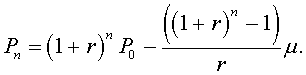
This solution is clearly more complicated and harder to
obtain than the previous section for the discrete Malthusian growth model
However, few other discrete dynamical models have a solution
that can be written as a formula depending only on the parameters, n, and P0, a closed form solution
In the next section, we will study a model with a simple
quadratic term on the right side of the equation, yet this discrete dynamical
model will have no closed form solution
It can only be simulated one step at a time to determine
the exact value of Pn.
When the solution becomes complicated or impossible to find
exactly, then we still would like to obtain some information about the qualitative
behavior of the model
The cobwebbing technique illustrated above gives us some
ideas on studying the behavior
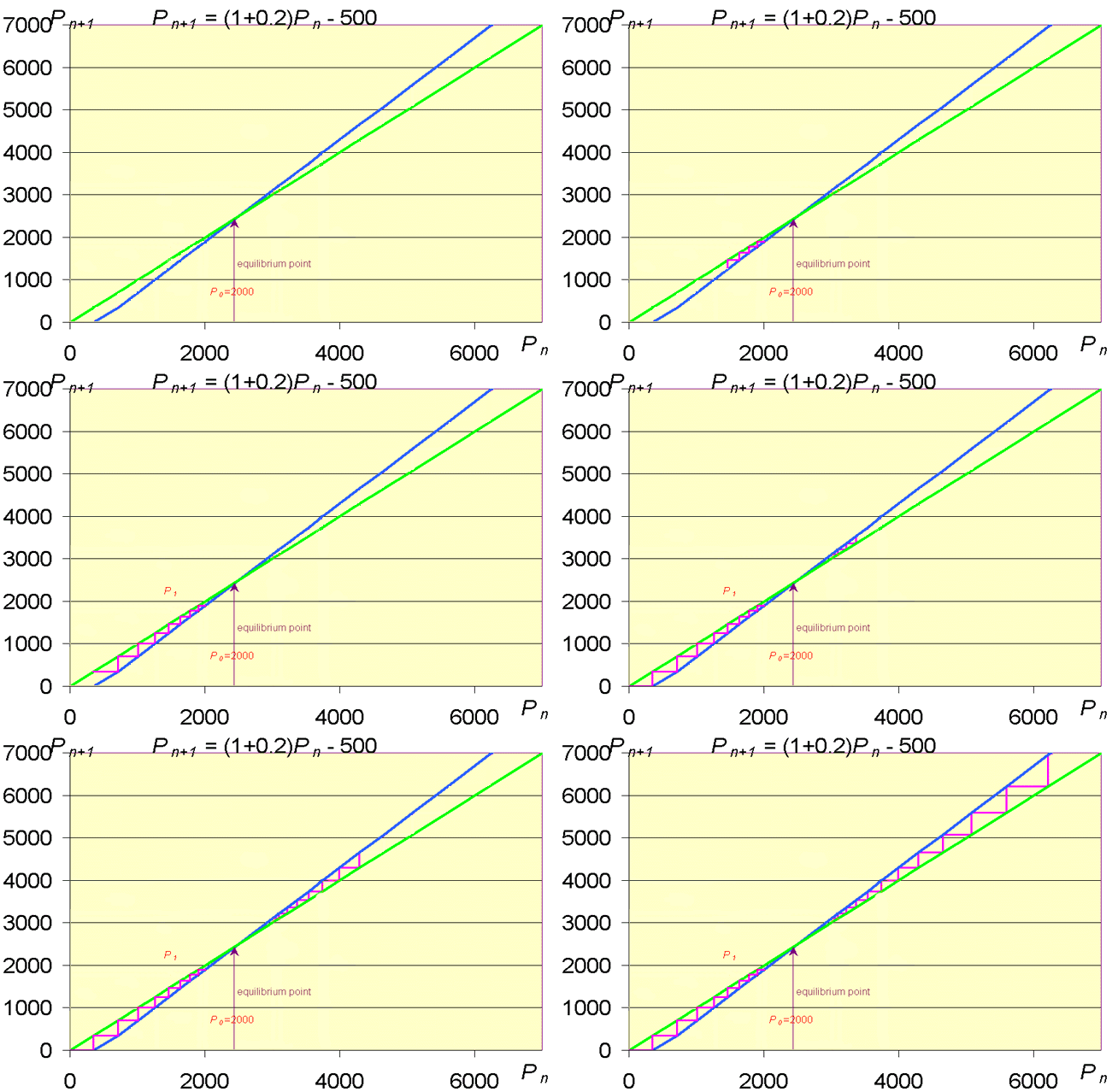
Below is the cobwebbing diagram for the discrete Malthusian
growth model with emigration, where r =
0.2 and m =
500
The green line represents the model, Pn+1=
1.2 Pn - 500, while the
blue line is what is known as the identity map,
Pn+1=
Pn
These lines intersect at the equilibrium point, which solves
the equation,
Pe
= 1.2 Pe - 500
or Pe = 2500.
One significant difference between this dynamical model
and one for the breathing is that iterations of the solution are going away
from the equilibrium
Thus, if the population begins above 2500, then it grows
increasingly larger, much like we saw in the previous section for the Malthusian
growth model
However, if the population starts below 2500, then more
animals leave than can be replaced, so the population is driven to extinction
The equilibrium for the discrete Malthusian growth model
with emigration is said to be unstable.
Stability of a Linear Discrete Dynamical
Model
Stability of an equilibrium
for a Discrete Dynamical Model is important for understanding how the model
behaves
Consider the Linear Discrete Dynamical Model
yn+1 = ayn + b
The equilibrium satisfies
For modeling situations, the equilibrium (if it exists)
must be positive (or zero), thus
Either a
< 1 and b
> 0
Or a
> 1 and b
< 0
Linear discrete dynamical models
have a single unique equilibrium
if the slope of the linear function, a,
is not 1
If a
= 1, then either there are no equilibria or all points are
equilibria (b
= 0)
An equilibrium of a linear
discrete dynamical model is stable if either of the following
conditions hold:
1. Successive iterations of the model approach the equilibrium.
2. The slope |a| is less than
1.
An equilibrium of a linear discrete
dynamical model is unstable if either of the following conditions
hold:
1. Successive iterations of the model move away from the equilibrium.
2. The slope |a| is greater than
1.