|
|
Math 121 - Calculus for Biology I |
|
|---|---|---|
|
San Diego State University -- This page last updated 26-Mar-01 |


Linear Discrete Dynamical Models - Worked Examples
|
|
Math 121 - Calculus for Biology I |
|
|---|---|---|
|
San Diego State University -- This page last updated 26-Mar-01 |
Linear Discrete Dynamical Models - Worked Examples
Example 1: For each of the following linear discrete dynamical systems, find the first three iterations, y1, y2, and y3. Also, determine the equilibrium value and determine if it is stable or not.
a. yn+1 = 1.05 yn - 200 with y0= 2000.
b. yn+1 = 0.6 yn + 50 with y0= 100.
Solutions:
a. Let y0= 2000, then
Similarly,
y3 = 1.05y2 - 200 = 1.05(1795) - 200 = 1684.75
For the equilibrium value, yn+1 = yn = ye. Thus,
0.05ye = 200
ye = 4000.
b. Let y0= 100 , then
y2 = 0.6 y1 + 50 = 0.6(110) + 50 = 116
y3 = 0.6 y2 + 50 = 0.6(116) + 50 = 119.6
For the equilibrium, let ye = yn+1 = yn, so that
0.4y = 50
y = 125
Example 2: A subject with an unknown lung ailment enters the lab for testing. She is given a supply of air that has an enriched amount of argon gas (Ar). (Recall that atmospheric argon occurs at 0.93% or a concentration of g = 0.0093.) After breathing this supply of enriched gas, two successive breaths are measured with c1 = 0.0736 and c2 = 0.0678 of Ar. The model for breathing is given by
Find the fraction of air breathed, q. What is the concentration of argon remaining in her lungs after 5 breaths?
Assume that her tidal volume is measured to be Vi = 220. Find the functional reserve volume, Vr, where q = Vi/(Vi + Vr).
Solution:
Since we are given g and the two consecutive values c1 and c2, we can find q
0.0678 = (1 - q)(0.0736) + 0.0093q
q = 0.0902
To find the concentration of Ar in her lungs after 5 breaths,
c3 = (1 - 0.0902)c2 + 0.0093(0.0902) = 0.9098(0.0678) + 0.000839 = 0.06252
c4 = 0.9098(0.06252) + 0.000839 = 0.05772
c5 = 0.9098(0.05772) + 0.000839 = 0.05336
To find the functional reserve volume we use the relationship 1 - q = Vr/(Vi + Vr).
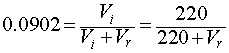
Thus, the functional reserve volume is Vr = 2219.
Example 3: A population of animals in a particular lake grows according to the Mathusian growth law. In addition, a constant number are entering the lake from a river. Thus, this population satisfies the discrete Malthusian growth model with immigration given by the equation:
where r is the rate of growth and m is the constant number entering the lake. In three successive weeks, the population is measured at P0 = 500, P1 = 670, and P2 = 874. Find the rate of growth r and immigration rate m, then determine the populations expected in the next two weeks.
Solution:
Substituting the given information into the discrete Malthusian growth model gives two equations and two unknowns (r and m)
670 = (1 + r)500 + m and 874 = (1 + r)670 + m.
Subtract the first equation from the second equation,
1 + r = 204/170 = 1.2
r = 0.2
Substituting this value for the rate of growth r back into the first equation gives
670 = 1.2(500) + m
m = 670- 600 = 70.
So the immigration rate m is given by m = 70.
Thus, the model can be rewritten as
The populations expected in the next two weeks, P3 and P4, are
P4 = 1.2(1118.8) + 70 = 1412.56