|

|
Math 121 - Calculus for Biology I
Spring Semester, 2009
Allometric Modeling
|
|
|
|
© 2001, All Rights Reserved, SDSU
& Joseph M. Mahaffy
San Diego State University -- This page last updated 09-Feb-09
|
|

Allometric Modeling
- Cumulative AIDS cases
- Link to Nonlinear Least Squares
- Allometric or Power
Law Model
- Review of Exponents
and Logarithms
- Graphing Exponentials
and Logarithms
- Worked Examples
- Finding Allometric
Models
- Log-Log Graphs
- References
Cumulative AIDS cases
- AIDS has had a significant impact on both personal behavior
and public policy
- The new protease inhibitors have significantly improved
the quality of life for those who are HIV positive; however, this has come
at a substantial cost to society
- The new drugs are extremely expensive, are difficult to
take because of the complex scheduling requirements to be effective, and have
many strong side effects (besides not always working for a particular person
or strain of the HIV virus)
- In turn, there are a number of people who are now avoiding
safe sex practices as they no longer fear the "Death Sentence" that used to
be associated with an HIV infection
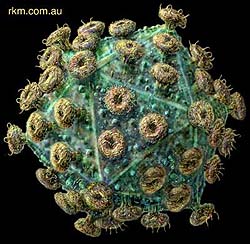
Below is a figure illustrating the HIV virus.
- Society needs to know the extent of this disease from both
an economic and sociological perspective
- We need to know what is the expected case load in the future
- This is an extremely complex modeling problem
- Below is a table of cumulative cases of AIDS between 1981
and 1992 [1]
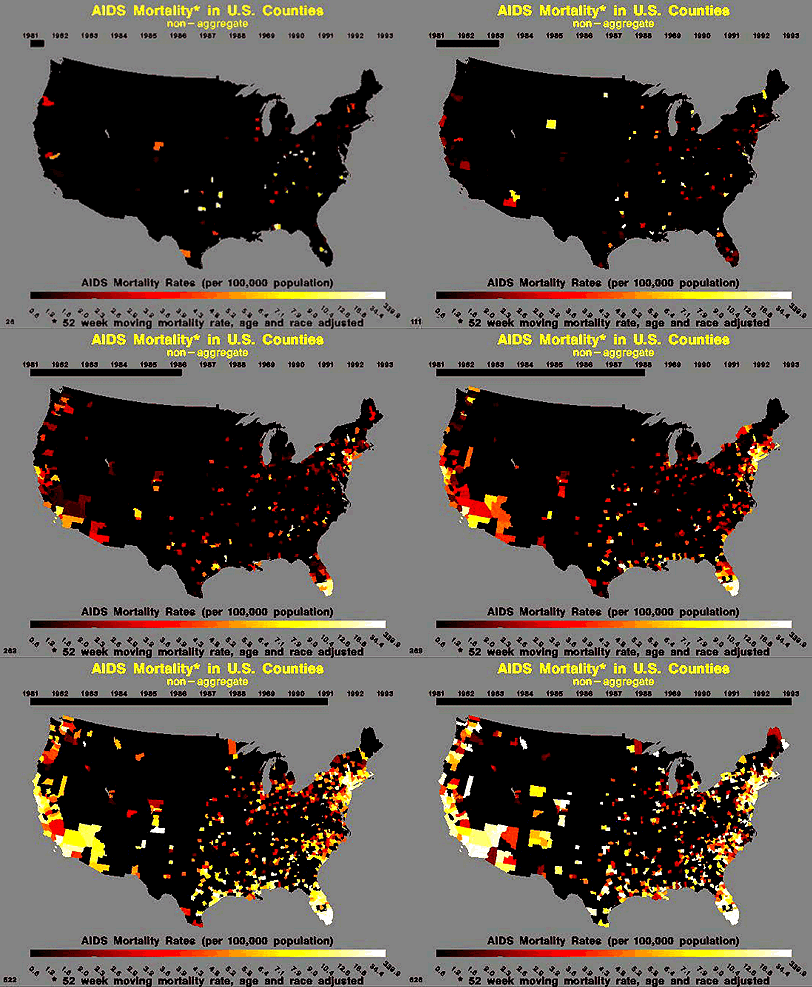
- An animated .gif shows the spread of the disease (through
mortality statistics) over a similar period of time
|
Year
|
Cumulative AIDS Cases (thousands)
|
|
1981
|
97
|
|
1982
|
709
|
|
1983
|
2,698
|
|
1984
|
6,928
|
|
1985
|
15,242
|
|
1986
|
29,944
|
|
1987
|
52,902
|
|
1988
|
83,903
|
|
1989
|
120,612
|
|
1990
|
161,711
|
|
1991
|
206,247
|
|
1992
|
257,085
|
- The data is clearly not linear
- There are general methods for finding the least squares
best fit to nonlinear data
- These techniques are very complicated an often difficult
to implement
- A hyperlink provides an applet for finding the
best nonlinear least squares fit to the data for cumulative AIDS cases,
which is different from the technique we'll show below.
Allometric
or Power Law Model
- Using a least squares fit to nonlinear data can be extremely
difficult
- A few standard nonlinear models used in biological applications
are easily analyzed
- The technique developed in this section is known as the
Power Law of Modeling
- It is also referred to as Allometric
Modeling
- Allometric models are used in modeling complex biological
phenomena
- Used when the actual mechanisms underlying the model
behavior are complex
- There is a need to make some predictions
Allometric Models
- Allometric models assume a relationship between two sets
of data, x and y, that satisfy a power law
of the form
y
= Axr,
- A and r are parameters that are chosen to best fit the data
in some sense
- This model assumes that when x = 0, then y
= 0
- This method provides its best predictive capabilities when
examining a situation that lies between the given data points
Example
- For example, if the number of species of herptofauna on
Carribean islands is determined for a collection of islands with varying areas
- This model would give a reasonable estimate for the
expected number of species on another Carribean island with an area that
lies between the collected data
- It would not be appropriate for extending to a large
continent as the area is significantly beyond the range of the collected
data
- It wouldn't even be appropriate for another island such
as Iceland, which lies in a different type of climate and has a different
geography.
- Allometric models are found by taking the logarithms of
the data
- Determine if the log-log graph of the data produces roughly
on a straight line
- If this is the case, then a power law relationship makes
a reasonable model
Below is an applet showing the linear least squares fit to
the logarithms of the data for cumulative aids cases, and the graph to the right
shows the modeling relationship with a normal scale. The allometric model has
x be time in years since 1980 and y
be the cumulative AIDS cases.
Alternate link
- The minimum least squares for the log of the data gives
J(A,r)
= 0.10
- The best slope is r
= 3.27
- The best intercept is ln(A)
= 4.42
- This gives the best fit power law for this model as
y
= 82.7x3.27.
- The graph of the power law provides a reasonable fit to
the data
- The fit is weakest at the end where we'd like to use the
model to predict the cumulative AIDS cases for the next year
- The model predicts 366,990 cases in 1993, which is clearly
too high from the given data
- The analysis gives some indication of the rate of growth
for this disease
- Gives a first approximation for improved models
- Could be applied to expected spread of another disease
with similar infectivity as HIV
- This modeling technique is valuable for analysis of other
data sets and can provide insight into the underlying biology of a problem
- A better fit to the data is shown in the nonlinear
least squares appendix that can be viewed through the hyperlink
- More examples are in the computer labs.
Review
of Exponents and Logarithms
Here are several properties of exponents that you should remember from algebra.
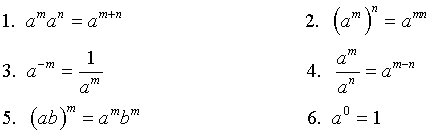
- For solving equations with exponents, the inverse function
of the exponent is needed, the logarithm
y = ax ,
- then the inverse equation that solves for x is given
by
x
= loga y .
- The a
in the above expression is called the base of the logarithm.

- The only property that requires the base of the logarithm
for Property 5
- All other properties are independent of which base is used
- The two most common logarithms that are used are log10 and loge
- The natural logarithm,
often denoted log or ln, is the one most commonly used (and is the default on
your calculator)
- We will soon see the importance of the natural base e
- Unless otherwise specified, use the natural logarithm. (Note
that Excel defaults to log10.)
Graphing
Exponentials and Logarithms
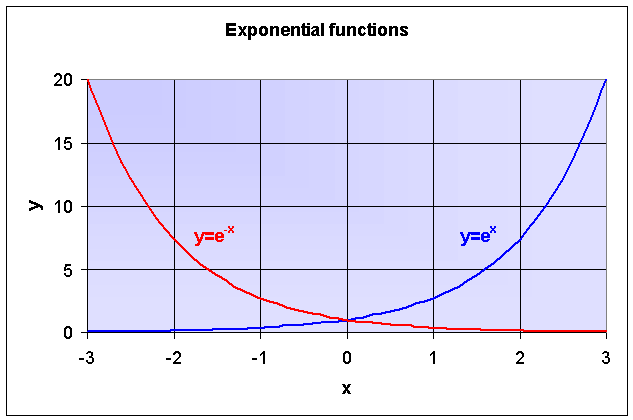
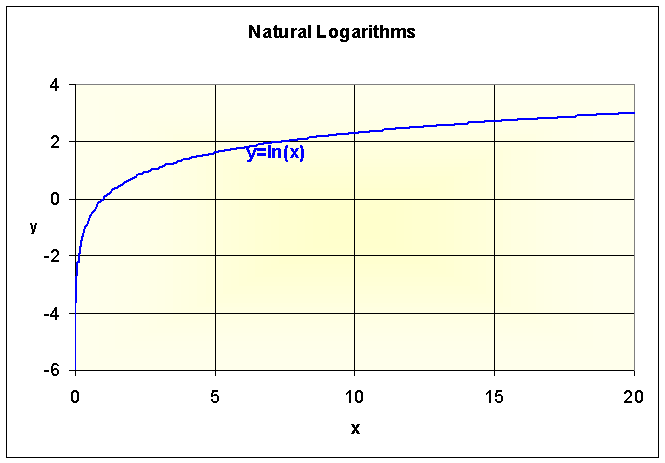
- The exponential function, ex, and the natural logarithm, ln(x), are inverse functions
- This section shows the graphs of these functions
- The study of ex arises
very naturally in Calculus applications
- For graphing purposes, e
is an irrational number between 2 and 3, more precisely, e
= 2.71828....
- The domain of ex
is all of x, becoming
extremely small very fast for x < 0 (a horizontal
asymptote of y = 0) and growing very
fast for x > 0
- Its range is y > 0
- Similarly, the graph of y = e-x
has the same y-intercept of 1, but its the mirror reflection through
the y-axis of y = ex
- Since ln(x) is the inverse function
of ex, the graph of this function mirrors the graph
of ex through
the line y = x
- The domain of ln(x) is x
> 0, while its range is all values of y
- As y = ln(x) becomes undefined at
x = 0, there
is a vertical asymptote at x
= 0
Finding
Allometric Models
- The Allometric model
for two sets of data, x and y satisfies a power law of the form
y
= Axr.
- We want to choose the parameters A and r that best fit the data
- Take the logarithm of both sides, then use the properties
of logarithms to simplify the equation

- From this formula, the logarithm of the data, ln(x) and ln(y), when graphed, fits a straight line
- Take X = ln(x), Y = ln(y), and a = ln(A), then
Y
= a + rX
- This is a line with a slope of r and a Y-intercept of ln(A)
AIDS Example
- Below is a table that includes both the data and the logarithms
of the data.
|
Year
|
ln(Year-1980)
|
Cumulative AIDS Cases (thousands)
|
ln(Cases)
|
|
1981
|
0
|
97
|
4.5747
|
|
1982
|
0.6931
|
709
|
6.5639
|
|
1983
|
1.0986
|
2,698
|
7.9003
|
|
1984
|
1.3863
|
6,928
|
8.8433
|
|
1985
|
1.6094
|
15,242
|
9.6318
|
|
1986
|
1.7916
|
29,944
|
10.307
|
|
1987
|
1.9459
|
52,902
|
10.876
|
|
1988
|
2.0794
|
83,903
|
11.337
|
|
1989
|
2.1972
|
120,612
|
11.700
|
|
1990
|
2.3026
|
161,711
|
11.994
|
|
1991
|
2.3979
|
206,247
|
12.237
|
|
1992
|
2.4849
|
257,085
|
12.457
|
Below shows a graph of the logs of the data (year-1980 and cumulative AIDS cases)
along with the best straight line fit.
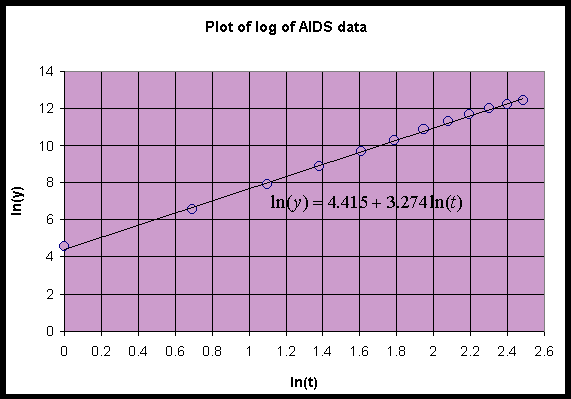
- This plot shows that when the logarithms of the data for
the cumulative AIDS cases are plotted against the logarithms of the time since
1980, then these logarithmic data lie fairly close to a straight line
- The data are flattening for the later years suggesting
a diminished rate of increase
- The least squares best fit of the straight line to the logarithms
of the data give a slope of r =
3.274 and intercept of a = ln(A) = 4.415, which gives A = 82.70
- Thus, an allometric or power law model
is a reasonable description of the data.
Log-Log Graphs
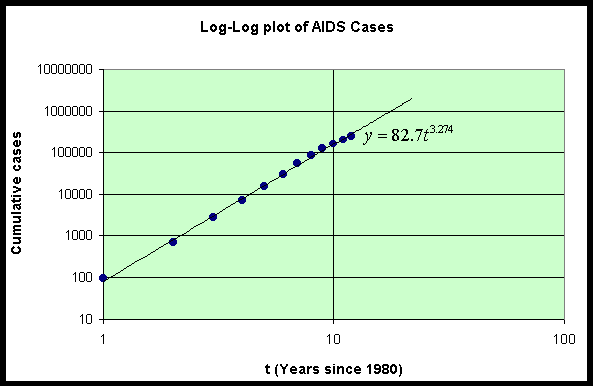
- The log-log plot allows direct plotting of the data
- The user graphs the data directly onto a graph with logarithmic
scales on the axes
- If the data falls on a straight line, one suspects an allometric
or power law model
- Below we show a plot of the original data on cumulative AIDS cases against the date - 1980 on a graph with logarithmic scaled axes.
Example:
Weight and Pulse
- Smaller animals have a higher pulse than larger animals
- Assume an allometric model (A Lab will justify this)
- Suppose a 17 g (or .017 kg) mouse has a pulse of 500 beats/min
and a 68 kg human has a pulse of 65
- Use these data to form an allometric model
- Predict the pulse for a 1.34 kg rabbit.
Solution:
P = Awk
ln(P) = ln(A) + k ln(w)
- This is a straight line in ln(P) and ln(w) with slope of k
and intercept of ln(A)
- From the data,
|
Animal
|
Weight (kg)
|
ln(w)
|
Pulse (beats/min)
|
ln(P)
|
|
Mouse
|
0.017
|
-4.075
|
500
|
6.215
|
|
Human
|
68
|
4.220
|
65
|
4.174
|
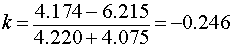
- This slope with one of the points is used to find ln(A):

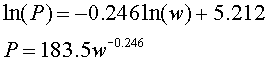
- If we use the first equation with a 1.34 kg rabbit, then it gives P = 171.
References:
[1] E. K. Yeargers, R. W. Shonkwiler, and J. V. Herod, 1996,
An Introduction to the Mathematics of Biology: with Computer Algebra Models,
Birkhäser, Boston.