|

|
Math 121 - Calculus for Biology I
Spring Semester, 2004
Quotient Rule - Examples
|
|
|
|
© 2001, All Rights Reserved, SDSU
& Joseph M. Mahaffy
San Diego State University -- This page last updated 12-Jan-04
|
|

Quotient Rule - Examples
- Differentiation
- Quotient Rule
- Graphing Rational Function
- Genetic Control by Repression
Differentiation
- Quotient Rule
Below are two functions for using the rules of differentiation.
The second function relates to the continuous version of the logistic growth
model.
Example 1:
Differentiate the following functions:

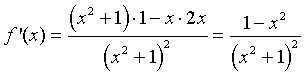
Solution: The
quotient rule is applied to each of these functions.

Graphing a Rational
Function
Example 2: Consider
the function:
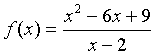
Differentiate this function. Find all intercepts, asymptotes,
and extrema. Graph the function.
Solution:
- The quotient rule for differentiation is applied to f(x) yielding

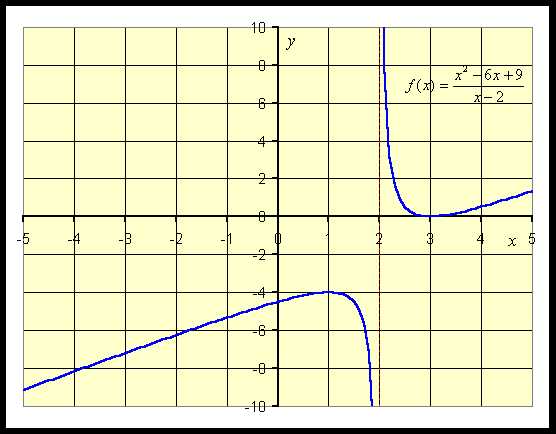
- The y-intercept is y
= f(0) = -9/2
- The x-intercept is found by solving f(x) = 0
- This is solved by setting the numerator equal to zero
x2 - 6x + 9 = (x
- 3)2 = 0
Asymptotes
- The vertical asymptotes are found finding when the denominator
is zero, so a vertical asymptote occurs
at x = 2
- There are no horizontal asymptotes as the power of the
numerator exceeds the power of the denominator.
Critical points
- Set the derivative equal to zero
- Set the numerator equal to zero
x2 - 4x + 3 = (x
- 1) (x - 3) = 0
- The critical points are xc = 1
and xc = 3
- Evaluating the function f(x) at these critical points
- Local maximum at (1, -4)
- Local minimum at (3, 0)
Example
3:
- In 1960, Jacob and Monod won a Nobel prize for their theory
of induction and repression
in genetic control
- Many metabolic pathways in cells use endproduct repression
of the gene or negative feedback to control important biochemical substances
- The biochemical kinetics of repression of a substance x
satisfies a rate function
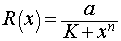
- Consider the specific rate function
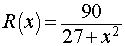
- Differentiate this rate function
- Sketch a graph of this rate function and its derivative
- Find all intercepts, any asymptotes, and any extrema for
the rate function and its derivative
- When is the rate function decreasing most rapidly?
Solution:
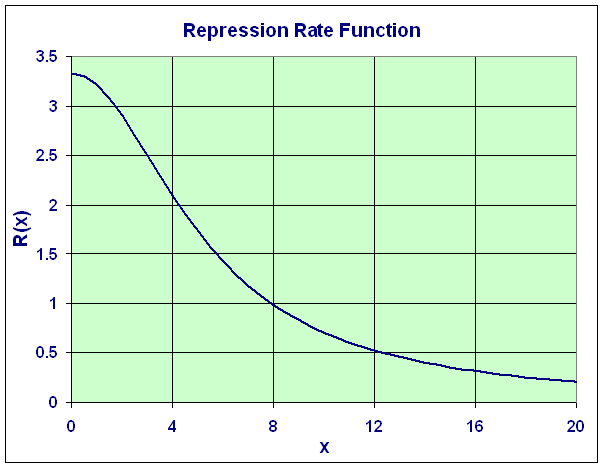
- The rate function has an R-intercept,
R(0) =
90/27 = 10/3
- There is a horizontal asymptote of R
= 0
- From the quotient rule, the derivative is
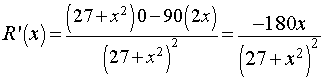
- For x
> 0, the derivative of the rate function is negative (decreasing)
- There is clearly a maximum at x
= 0
- A rate function doesn't make sense for x
< 0
- Below is a graph of the rate function
- The derivative has an intercept at (0,
0)
- A horizontal asymptote R'
= 0
- The derivative can be written
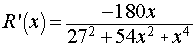

- This second derivative is zero when x
= 3 (x
= -3 is outside the domain)
- Thus, R'
(x) has a minimum at
(3, -5/12)
- Below is a graph of the derivative of the repression rate
function.
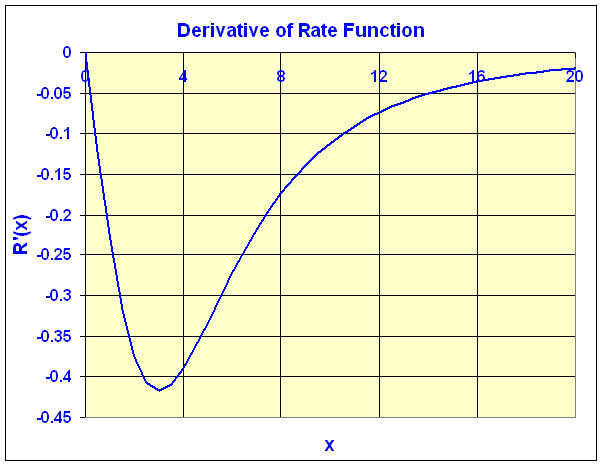
- The original rate function is decreasing most rapidly at
x = 3