Math 121 - Calculus for Biology I
Spring Semester, 2001
Logistic Growth - Worked Examples
San Diego State University -- This page last updated 03-Apr-01
|
|
Math 121 - Calculus for Biology I |
|
|---|---|---|
|
San Diego State University -- This page last updated 03-Apr-01 |

Logistic Growth - Worked Examples
Solution:
p2 = 1.2(224) - .0004(224)2 = 248.7
p3 = 1.2(248.7) - 0.0004(248.7)2 = 273.7
-0.2pe + 0.0004pe2 = 0
pe(0.0004pe - 0.2) = 0
f(p)= 1.2p - 0.0004p2
where n is measured in hours
a. Assume that p0 = 500 and find the population for the next three hours, p1, p2, and p3.
b. Find the p-intercepts and the vertex for
Sketch a graph of g(p).
c. By finding when the growth rate is zero, determine all equilibria for this model.
Solution:
a. We find the first three iterations by substituting each successive value into the given updating function. Thus,
p2 = 524 + 0.05(524)(1 - 0.0001(524)) = 549,
p3 = 549 + 0.05(549)(1 - 0.0001(549)) = 574.
b. Since g(p) = 0.05 p(1 - 0.0001p), the p-intercepts are found by solving
g(p) = 0.05 p(1 - 0.0001p) = 0,
which gives either p = 0 or 1 - 0.0001p = 0. The latter is equivalent to p = 10,000.
The vertex occurs halfway between the p-intercepts, so p = 5,000 and g(5000) = 0.05(5000)(1 - 0.0001(5000)) = 125.
The graph of g(p) is a standard parabola, which is shown below showing the p-intercepts and the vertex.

c. From the graph above, it is clear that the growth rate is zero at 0 and 10,000, so the equilibria occur at
pe = 0 and 10,000.
Example 3 (Logistic Growth with Emigration): We extend the previous example to include the possibility that the population might be affected by immigration or emigration. Suppose that the growth rate for a population is given by
This says that between each generation there is a 71% growth rate, while 0.001pn2 are lost due to crowding and 7 emigrate. The discrete dynamical model for this population model is given by
where n is measured in generations.
a. Assume that p0 = 100 and find the population for the next three generations, p1, p2, and p3.
b. Find the p -intercepts and the vertex for g(p) and sketch a graph of g(p).
c. By finding when the growth rate is zero, determine all equilibria for this model.
Solution:
a. As we did in the previous example, we iterate this discrete logistic model with emigration to obtain the next three generations. Thus,
p2 = 154 + 0.71(154) - 0.001(154)2 - 7 = 233,
p3 = 233 + 0.71(233) - 0.001(233)2 - 7 = 337.
b. Since g(p) = 0.71 p - 0.001p2 - 7 = -0.001(p2 - 710p + 7000), the p-intercepts are found by solving
g(p) = -0.001(p2 - 710p + 7000) = -0.001(p - 10)(p - 700) = 0,
which gives either p = 0 or p = 700.
The vertex occurs halfway between the p-intercepts, so
p = 355 and g(355) = -0.001(345)(-345) = 119.
The graph of g(p) is a parabola, which is shown below showing the p-intercepts at p = 10 and 700 and the vertex.

c. From the graph above, it is clear that the growth rate is zero at 10 and 700, so the equilibria occur at
pe = 10 and 700.
Pe = 0 and Pe = 100 ln(a)
Hassell's Model

Graph the updating function, H(Pn), for Pn > 0


Analysis of Hassell's Model


Stability of the Equilibria

H '(0) = a > 1
Solution is unstable and grows exponentially away from 0


Analysis of the behavior of the chalone model
There is no reason that the discrete dynamical model should have a quadratic form and in fact, because a quadratic function goes negative for large values of p, this model becomes very unrealistic. Hassell modified this growth model (especially for insect populations) to use a rational function response (a rational updating function).
Consider the discrete dynamical model given by the equation
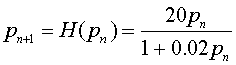
where n is measured in generations.
a. Assume that p0 = 200 and find the population for the next four generations, p1, p2, p3, and p4.
b. Find the p -intercepts and the horizontal asymptote for H(p) and sketch a graph of H(p) for p > 0. (Note that the vertical asymptote occurs at p = -50, which is outside the biologically valid range as p should be greater than or equal to 0.)
c. By solving pe = H(pe), determine all equilibria, pe, for this model.
Solution:
a. Once again, we iterate this nonlinear dynamical model by Hassell by substituting the value of p0 = 200 into the model. The result is
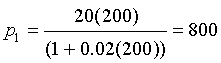
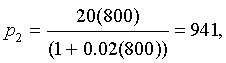
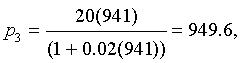

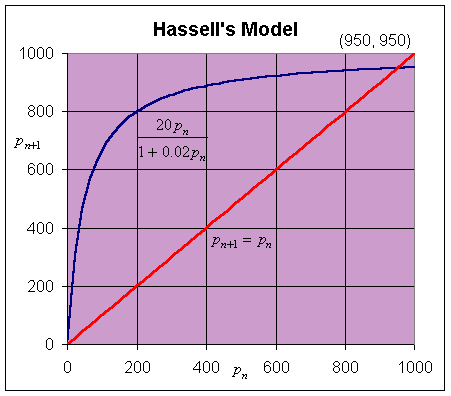
b. The only intercept for H(p) is (0, 0), while the horizontal asymptote is H = 1000. Below is a graph of Hassell's updating function along with the identity map. The intersections give the equilibria.
c. The equilibria are found by setting pe = pn+1 = pn, so we solve
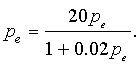
One solution is clearly pe = 0. Next we multiply both sides by (1 + 0.02 pe)/pe, which gives
Solving this equation gives the other equilibrium,
pe = 950.
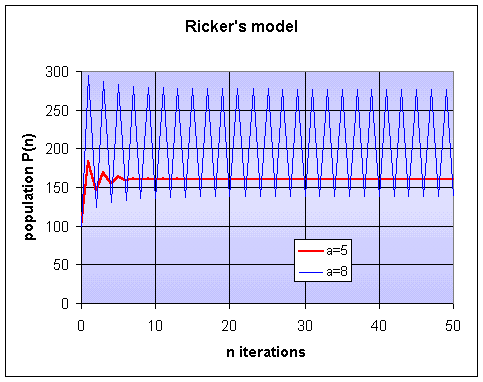
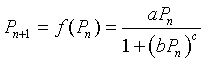
Example 4: Let Pn be the population of fish in any year n. Consider Ricker's model for population growth given by the equation
where a = 7 and b = 0.02. Sketch a graph of R(P) with the identity function, showing the intercepts, all extrema, and any asymptotes. Find all equilibria of the model and describe the behavior of these equilibria. Let P0 = 100, and simulate the model for 50 years, graphing the solution.
Solution: First, we see that the only intercept is the origin, (0, 0). Since the negative exponential dominates in the function R(P), there is a horizontal asymptote of Pn+1 = 0. To find the extrema, we differentiate R(P). Applying the product rule we obtain:
This expression is zero only when 1 - 0.02P = 0 or Pc = 50. Thus, there is a critical point for the updating function at
The graph of the updating function along with the identity function is shown below. They intersect at the equilibria, which are calculated later.
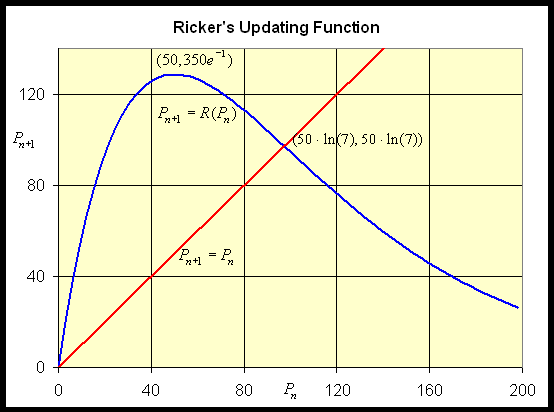
To find the equilibria, we substitute Pe for Pn+1 and Pn in the Ricker's model. The resulting equation is given by
One equilibrium is given by Pe = 0, so we can divide out Pe, leaving
This gives the other equilibrium Pe = 50 ln(7) ~ 97.3.
To find the behavior of the solution near each of these, we must substitute the value of the equilibrium into the expression for the derivative. First, we analyze the stability of Pe = 0. We see that,
which is unstable, and the population grows away from the equilibrium Pe = 0.
Next we consider Pe = 50 ln(7). Substituting into the formula for the derivative gives
Thus, -1 < R '(50 ln(7)) < 0, so we have a stable equilibrium point with solutions oscillating, but approaching the equilibrium, Pe = 50 ln(7).
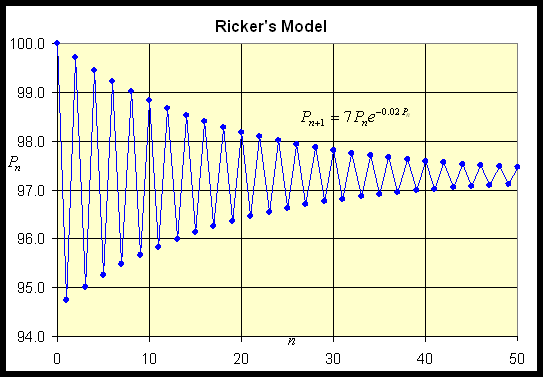
The simulation with P0 = 100 is shown in the graph below. The solution is slowly oscillating toward the equilibrium, as can be seen with 50 iterations.
Example 5: Repeat the previous problem with a = 9.
Solution: Many of the computations carry over from the example above. The only intercept is the origin, (0, 0), and there is a horizontal asymptote of Pn+1 = 0. The derivative is only slightly changed as the leading constant is the only variation, so
As in the previous example, the critical point satisfies Pc = 50, which gives a maximum at
The graph of the updating function along with the identity function is shown below with the important points labeled.
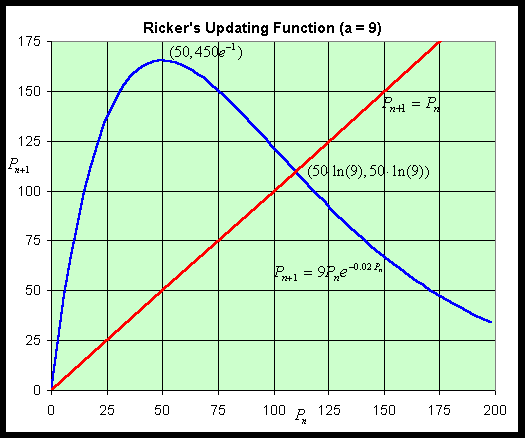
The equilibria are found just like the previous example by using Pe for Pn+1 and Pn in the Ricker's model. The resulting equation is given by
The calculations are very similar giving the two equilibria, Pe = 0 and Pe = 50 ln(9) ~ 109.86.
The stability analysis uses the same techniques as before, but the behavior changes at the upper equilibrium. Near Pe = 0, we evaluate the derivative and obtain
which is unstable with the population growing away from this equilibrium.
Near Pe = 50 ln(9), we find that
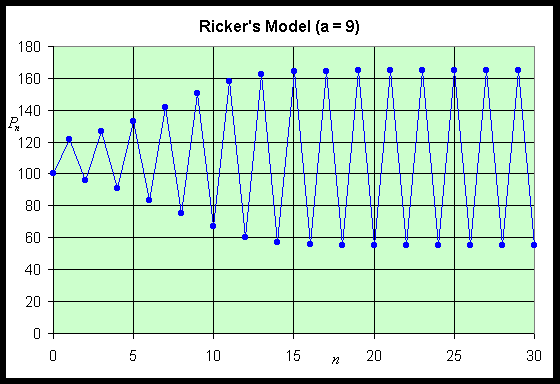
Thus, R '(50 ln(9)) < -1, so we have an unstable equilibrium point with solutions oscillating and moving away from the equilibrium. Below is a simulation with 30 iterations, starting with P0 = 100. Clearly, the solution oscillates with increasing amplitude. The solution goes to a period 2 behavior, oscillating between 55 and 165.
Hassell's Model for Population Growth
Example 3: Suppose that a population of insects is measured weekly and appears to follow Hassell's model given by:
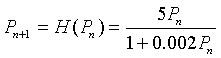
Find the equilibria for this model and determine the behavior of the population near the equilibria. Also, start with an initial population of P0 = 500, and simulate this model for 10 weeks.
Solution:



Chalone Model Analysis


[1] W. S. Bullough and E. B. Laurence (1968) Chalones and cancer, Nature 220, 134-135.
Model for Cellular Division with Inhibition
Example 4: Consider the mitotic model given by the equation

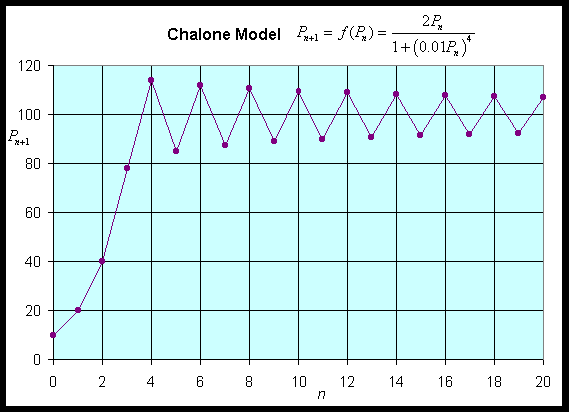
Find the equilibria for this model and determine the behavior of the population near the equilibria. Also, start with an initial population of P0 = 10, and simulate this model for 20 mitotic divisions.
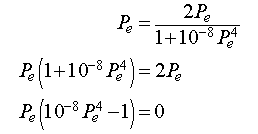
Solution: