Math 121 - Calculus for Biology I
Spring Semester, 2009
San Diego State University -- This page last updated 19-Jan-09
|
|
Math 121 - Calculus for Biology I |
|
|---|---|---|
|
|
San Diego State University -- This page last updated 19-Jan-09 |
|

Outline of Chapter
|
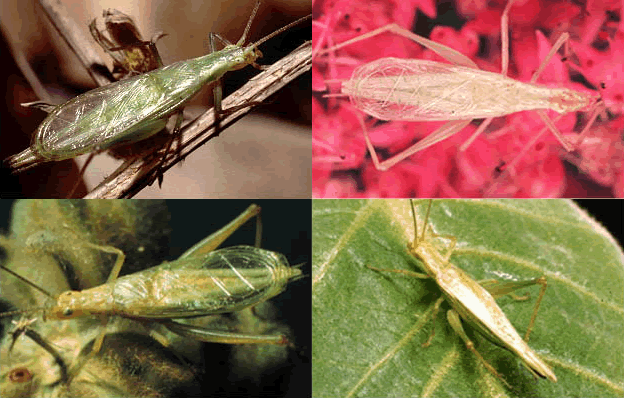
Chirping Crickets and Temperature
source for linear_ckt.java -Alternate link
Dolbear's Cricket Equation as a Linear Model
The line creates a mathematical model - the temperature as a function of the rate snowy tree crickets chirp
These questions show the complex relationship between the biology of the problem and the mathematical model. The first two are biological with mathematics playing a very limited role.
1. Clear discrepancies: Different species, Approximations, Still similar
2. This biological thermometer has limited use: Snowy tree crickets only chirp for a couple months of the year and mostly at night with temperatures above 50oF.
Last 2 questions are more mathematical.
3. The range of validity in temperatures for the model gives the domain, which in this case is mostly between 50oF and 85oF.
4. The folk formula is less accurate than the model formed by data, but it is much more easily applied.
The Bessey model used a linear least squares, but would a quadratic fit the data better? Would it give better insight into the problem.
The slope-intercept form of the line.
Some definitions:
1. The variable x is the independent variable.
2. The variable y is the dependent variable.
3. The slope is m.
4.The y-intercept is b.
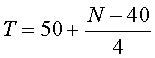
Note that the variables x and y are only used for convenience. When describing a mathematical model using a linear model, one often chooses variables that more closely match the objects being observed. The cricket equation given above can be written
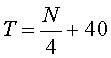
The independent variable is N, the rate that the crickets are chirping (number of chirps per minute). The temperature, T, is the dependent variable. The slope is 1/4, and the T-intercept is 40. A graph of this equation is seen in the applet above by pressing the button for Dolbear.
The point-slope form of a line.
A line passing through the point (x0, y0 ) with slope of m has the form

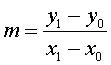
Given two points (x0 , y0 ) and (x1 , y1), then the slope m is given by:
Examples are found in the hyperlinked Worked Examples section.
All of the conversions for measurements, weights, temperatures, etc. are linear relationships.
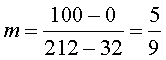
Converting Fahrenheit to Celsius
The slope is
The point-slope form of the line gives
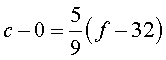 or
or 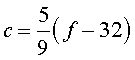
The temperature f in Fahrenheit is the independent variable. The equation of the line gives the dependent variable c in Celsius.
Below are JavaScript programs for a variety of linear conversions or linear relationships.
Example: Find a linear relationship that determines a weight in pounds given a weight in kilograms.
Solution: From the JavaScript program, we find 1 kilogram is 2.2046 pounds. If we let y be the weight in pounds and x be the weight in kilograms, the linear relationship is given by
Average juvenile height as a function of age [4]
|
Age |
|
|
|
|
|
|
|
|
Height (cm) |
|
|
|
|
|
|
|
The height, h, is graphed as a function of the age, a, with the data from the table. The data almost lie on a line, which suggests a linear model.
source for linear_hta.java ---Alternative Figure -Alternate link
This model is good for finding the average height of a child for any age between 1 and 13. The linear least square best fit to the data is
The next section will explain finding the linear least squares best fit or linear regression to the data.
For modeling, it is valuable to place units on each part of the equation.
What questions can you answer with this mathematical model?
Answers:
1. The model predicts that the average eight year old will be 124 cm, which is found by setting a = 8 in the model.
2. The height intercept represents the height of a newborn., so this model predicts that a newborn would be 72.3 cm. However, this is outside the range of the data, which makes its value more suspect.
3. The model indicates that the growth rate is about 6.5 cm/year, so the six year old should grow about 6.5 cm and be 116.5 cm at age 7 though the average 7 year old as predicted by the model would be 117.5 cm.
What are some of the limitations and how might the model be improved?
[1] H. A. Allard, The chirping rates of the snowy tree cricket (Oecanthus niveus) as affected by external conditions, Canadian Entomologist (1930) 52, 131-142.
[2] C. A. Bessey and E. A. Bessey, Further notes on thermometer crickets, American Naturalist (1898) 32, 263-264.
[3] A. E. Dolbear, The cricket as a thermometer, American Naturalist (1897) 31, 970-971.
[4] David N. Holvey, editor, The Merck Manual of Diagnosis and Therapy (1987) 15th ed., Merck Sharp & Dohme Research Laboratories, Rahway, NJ.