|

|
Math 121 - Calculus for Biology I
Spring Semester, 2001
Limits, Continuity, and the Derivative
|
|
|
|
© 2001, All Rights Reserved, SDSU
& Joseph M. Mahaffy
San Diego State University -- This page last updated 29-Apr-01
|
|

Limits, Continuity, and the Derivative
- Limits
- Continuity
- Derivative
- This is a theoretical section that studies the concepts
of limits, continuity, and the derivative
- The definition of the derivative
is presented
- This section sketches the formal mathematics needed for
the derivative
- A complete understanding is beyond the scope of this course
- Earlier noted how the derivative is related to the slope
of tangent line for a curve at a point
Limits
- Conceptually, the limit of a function
f(x) at some point x0 simply means that
if your value of x is very close to the
value x0, then the function f(x) stays very close to
some particular value.
Definition: The
limit of a function
f(x) at some point x0 exists and is equal to L if and only if every "small" interval about the limit
L, say the interval (L - e,
L
+ e),
means you can find a "small" interval about x0, say the interval (x0 - d,
x0 + d),
which has all values of f(x) existing in the former
"small" interval about the limit L, except possibly at x0 itself.
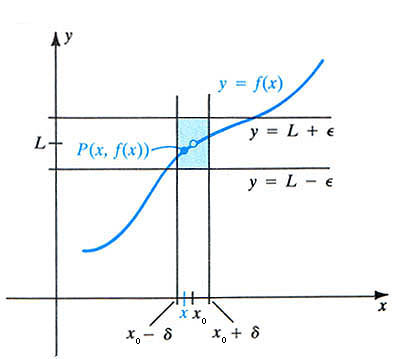
- This is a difficult concept to fully appreciate. However,
you should be able to grasp the idea through several examples.
Examples:
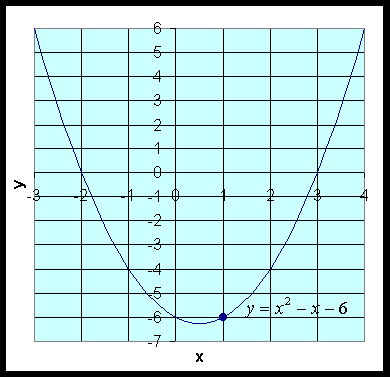
1. f(x) = x2 - x
- 6
- Find the limit as x
approaches 1
- From either the graph or from the way you have always evaluated
this quadratic function that as x approaches
1, f(x) approaches
-6, since f(1) = -6.
Fact:
Any polynomial,
p(x), has as its limit at some x0, the value of p(x0).
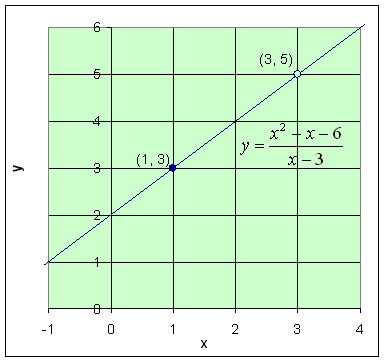
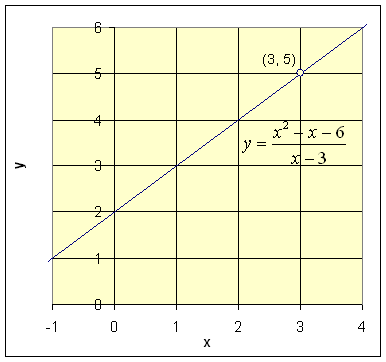
2. The rational function
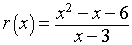
- Find the limit as x
approaches 1
- If x is not 3,
then this rational function reduces to r(x) = x + 2
- So as x approaches 1, this function simply goes to 3.
Fact: Any rational
function, r(x) = p(x)/q(x),
where p(x) and q(x) are polynomials
with q(x0) not zero,
then the limit exists with the limit being r(x0).
3. The
rational function in Example 2.
- Find the limit as x approaches 3
- Though r(x) is not defined at x0 = 3, arbitrarily "close"
to 3, r(x) = x + 2
- So as x approaches 3, this function goes to 5
- Its limit exists though the function is not defined at x0 = 3.
4. Consider the rational
function f(x) = 1/x2
- Find the limit as x approaches 0, if it exists
- This function has a limit for any value of x0 where the denominator
is not zero
- However, at x0 = 0, this function
is undefined
- Thus, the graph has a vertical asymptote at x0 = 0
- This means that no limit exists for f(x) at x0 = 0
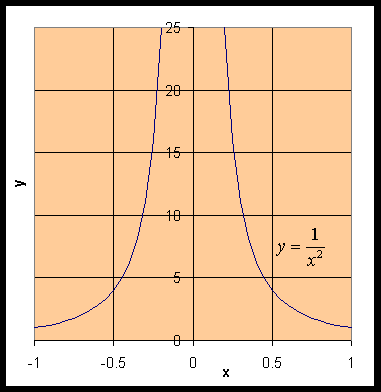
Fact: Whenever you have
a vertical asymptote at some x0, then the limit fails to
exist at that point.
5. The rational function
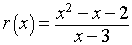
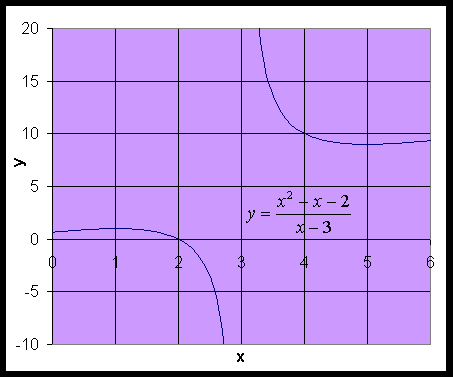
- Find the limit as x
approaches 3, if it exists
- This function has a limit for any value of x0 where the denominator
is not zero
- However, at x0 = 3, this function
is undefined
- The function is not approaching zero in the numerator near
x0 = 3
- Thus, the graph would show a vertical asymptote at x0 = 3
- This means that no limit exists for r(x) at x0 = 3
6. The
Heaviside function is often used to specify
when something is "on" or "off." The Heaviside function is defined as
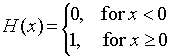
- This function clearly has the limit of 0 for any x <
0, and it has the limit of 1 for any x > 0
- Even though this function is defined to be 1 at x = 0, it does not have
a limit at x0 = 0
- If you take some "small" interval about the proposed limit
of 1, say e = 0.1,
then all values of x near 0 must have H(x) between 0.9
and 1.1
- But take any "small" negative x
and H(x) = 0, which is not in
the desired given interval
- Thus, no limit exists for H(x)
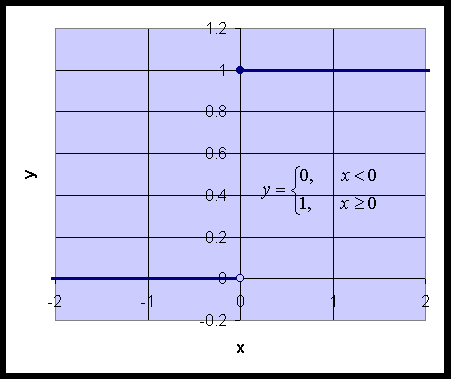
Perspective:
Whenever a function is defined
differently on different intervals in a manner similar to the Heaviside
function above, you need to check the places where the function changes in definition
to see if the function has a limit at these x values where the function changes. (It might also
have asymptotes at other points where again you would check.)
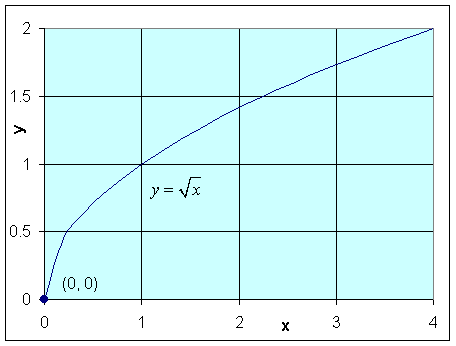
7. The fractional power
function f(x) = x1/2
- Find the limit as x approaches 0, if it exists
- This function is not defined for x
< 0, so it cannot have a limit
at x = 0, though it is said
to have a right-handed limit
Summary of Limits: Most
of the functions that you regularly examine have limits. Usually, the problems
arise at points x0 when there
is a vertical asymptote, the function is defined differently on different intervals,
or special cases like the square root function.
Continuity
- Closely connected to the concept of a limit is that of continuity
- Intuititvely, the idea of a continuous function is what
you would expect
- If you can draw the function without lifting your pencil,
then the function is continuous
- Most practical examples use functions that are continuous
or at most have a few points of discontinuity
Definition: A
function f(x) is
continuous at a point x0 if the limit
exists at x0 and is equal
to f(x0).
- The examples above should also help you appreciate this
concept
- In all of the cases except Example
3, the existence of a limit also corresponds to points of continuity
- Example 3 is not continuous
at x0 = 3 though a limit
exists here, as the function is not defined at 3
- Examples 3 and 5
are discontinuous only at x0 = 3
- Examples 4,
6 and 7
are discontinuous only at x0 = 0
- At all other points in the domains of these examples
are continuous.
Example Comparing Limits
and Continuity
- An example is provided to show the differences between limits
and continuity
- Below is a graph of a function, f(x),
that is defined on the interval [-2, 2], except
at x = 0, where there is
a vertical asymptote
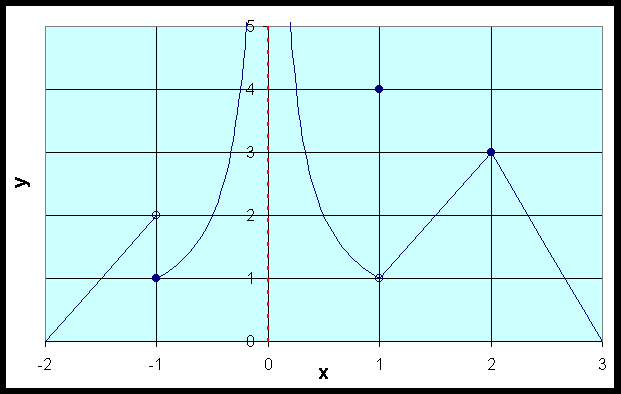
- The difficulties with this function occur at integer values
- At x
= -1, the function has the value f(-1)
= 1
- It is clear that the function is not continuous nor
does a limit exist at this point
- At x
= 0, the function is not defined (not continuous nor has any limits)
as there is a vertical asymptote
- At x
= 1, the function has the value f(1)
= 4
- The function is not continuous at x
= 1, but the limit does exist with
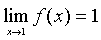
- At x
= 2, the function is continuous with f(2)
= 3, which also means that the limit exists
- At all non-integer values of x
the function is continuous (hence its limit exists)
Derivative
- The primary reason for the discussion above is for the proper
definition of the derivative
- In the previous sections, we noted that the derivative at
a point on a curve is the slope of the tangent line at that point
- This motivation is what underlies the definition given
below
Definition: The derivative
of a function f(x)
at a point x0 is denoted
by f '(x0) and satisfies
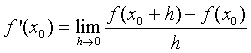
provided this limit exists.
Examples:
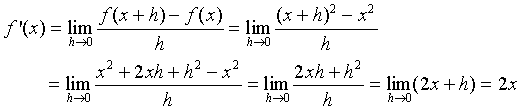
1. Let
us use this definition to find the derivative of f(x) = x2.
2.
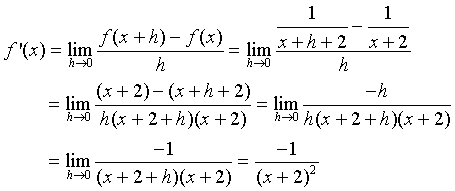
We repeat this computation to find the derivative of f(x) = 1/(x + 2) (for x
not equal to -2).
- Clearly, we do not want to use this formula every time we
need to compute a derivative
- The next section gives much easier formulae for finding
derivatives
- Another very easy way to find derivatives is using the Maple
diff command