|

|
Math 121 - Calculus for Biology I
Fall Semester, 2003
Appendix for Least Squares Analysis
|
|
|
|
© 2001, All Rights Reserved, SDSU
& Joseph M. Mahaffy
San Diego State University -- This page last updated
10-Aug-02
|
|
 Appendix for Least Squares
Analysis
Appendix for Least Squares
Analysis
- The best known technique for fitting data to a
given function is the method of least squares.
- This technique assumes that the
x values of the data are correct.
- The difference between the y values
of the data and the y values of the
proposed model function are evaluated at each x value
in the data set.
- The sum of the squares of these errors is then
minimized with respect to the parameters in the model
function.
- For a straight line, the parameters are the
slope of the line and the intercept.
- Note that the model function need not be a
straight line to apply this technique, but our analysis below will
only examine the case of a straight line model.
- Assume a data set consisting of
n data points: (x1,
y1), (x2,
y2), ... , (xn, yn).
- The mathematical model is a straight line
given by the formula
y(x) = ax +
b.
- Find a slope, a, and an
intercept, b, that minimizes
the square of the error in the distance between the
yi
values of the data points and the
y value of the line.
- The error between each of the data points and
the line are given by
ei = yi -
y(xi) =
yi - (axi +
b), i = 1,...n.
- The least squares best fit is found by
minimizing the function
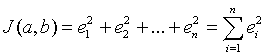
with respect to the variables a and
b.
- This is done by taking the partial derivatives
of J(a,b) with respect to
a and b and setting these
partial derivatives equal to zero. In this course we will be
learning about derivatives and how they relate to finding minimum
values of functions.
- The symbol S is summation notation
and simply stands for adding together a collection of similar
terms.
The details of this analysis are omitted, since it
does require a little more knowledge of Calculus. First, we define
the mean of the x
values of the data points as

The value for the slope of the line that best fits
the data is given by
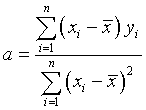
With the slope computed, the intercept is found
from the formula
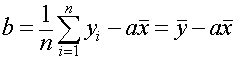
Example: Let us apply this to our example beginning the main
section. There are four data points in the E. coli example, (10,7130), (20,4580),
(30,2420), and (40,810). First we compute
the mean of the times
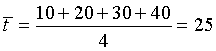
The slope a is found by the
following calculation.
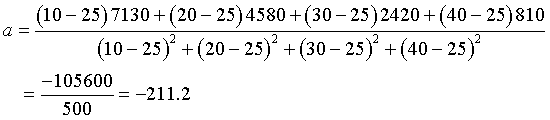
Similarly, the c-intercept,
b, is readily computed to give

The answer on the main page rounds the values of
a and b to three significant
figures.