|
|
Math 121 - Calculus for Biology I |
|
|---|---|---|
|
|
San Diego State University -- This page last updated 04-Feb-09 |
|

Function Review and Quadratics
|
|
Math 121 - Calculus for Biology I |
|
|---|---|---|
|
|
San Diego State University -- This page last updated 04-Feb-09 |
|
Function Review and Quadratics
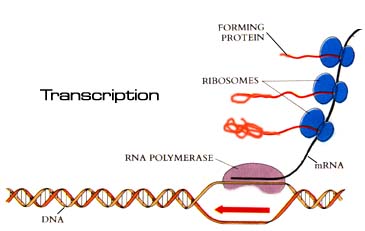
Transcription of a bacterial gene is a controlled sequence of steps, where the protein, RNA polymerase, reads the genetic code and produces a complementary messenger RNA (mRNA) template. This mRNA is a short-lived blueprint for the production of a specific protein that has some particular activity in the bacterial cell.
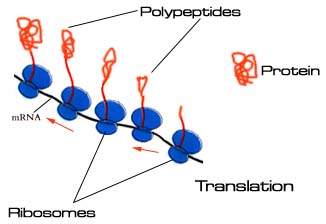
Translation of the mRNA in bacteria begins shortly after transcription starts, with ribosomes (consisting of ribosomal RNA and ribosomal proteins) reading the triplet codons on the mRNA. The ribosome sequentially assembles a series of amino acids (based on the specific codons read), which form a polypeptide. It is believed that the physical properties of the atoms in the polypeptide cause it to fold passively into a tertiary structure that either becomes an active protein or, when combined with other elements from the cell (such as another polypeptide or lipids), becomes an active protein or enzyme.
|
|
|
|
|
|
|
|
|
|
|
|
|
|
for some value of a, which is the slope of the linear model.
Squared these terms and add them together to give
Definitions and Properties of Functions
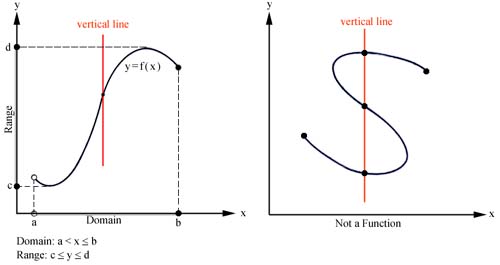
Function: A function of a variable x is a rule f that assigns to each value of x a unique number f(x). The variable x is the independent variable, and the set of values over which x may vary is called the domain of the function. The set of values f(x) over the domain gives the range of the function.
Often a function is described by a graph in the xy-coordinate system. By convention x is the domain of the function and y is the range of the function. The graph is defined by the set of points (x, f(x)) for all x in the domain.
The vertical line test states that a curve in the xy-plane is the graph of a function if and only if each vertical line touches the curve at no more than one point.
Addition and multiplication of functions are carried out symbolically by standard algebraic techniques.
Example 1: Let f(x) = x - 1 and g(x) = x2 + 2x - 3. Determine f(x) + g(x) and f(x)g(x).
Solution: The addition of the two functions satisfies:
f(x) + g(x) = x - 1 + x2 + 2x - 3 = x2 + 3x - 4.
The product or multiplication of the two functions is given by:
f(x)g(x) = (x - 1)(x2 + 2x - 3) = x3 + 2x2 -3x - x2 - 2x + 3 = x3 + x2 - 5x + 3.
Example 2: Determine f(x) + g(x) for

Solution: In this case, the addition of the two functions is simplified by finding a common denominator

Composition of Functions is another important operation. Given functions f(x) and g(x), the composite f(g(x)) is formed by inserting g(x) wherever x appears in f(x).
Example 3: Let f(x) = 3x + 2 and g(x) = x2 - 2x + 3. Determine f(g(x)) and g(f(x)).
Solution: The two composite functions are readily evaluated by substituting one of the functions in for x in the other function. We see that
f(g(x)) = 3( x2 - 2x + 3) + 2 = 3x2 - 6x + 11,
while
g(f(x)) = (3x + 2)2 - 2(3x + 2) + 3 = 9x2 + 6x + 3.
More Worked Examples are provided on a hyperlinked page.
Quadratic Equations and Quadratic Functions


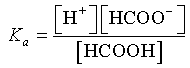

which is a quadratic equation in [H+] and is easily solved using the quadratic formula.
The solution is given by

Only the positive solution is taken to make physical sense.
Example 4: Find the concentration of [H+] for a 0.1N solution of formic acid.
Solution: Since formic acid has Ka = 1.77×10⁻⁴ and we have a 0.1N solution of formic acid, then we can substitute into the formual given above to yield:

Thus, the concentration of acid in the 0.1 N solution is [H+] = 4.12 ×10⁻³, which gives a pH of 2.385. (Note that pH is defined to be -log10 [H+].)
Quadratic equations: The general quadratic equation is given by the formula:

Two methods for solving quadratics:
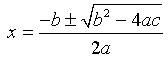
In the example above, the quadratic formula was needed because we didn't know either Ka or x.
Example 5 (Factoring): Consider the following quadratic equation:
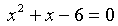
Find the values of x that satisfy this equation.
Solution: The equation above is easily factored to give the solution.

Example 6 (Quadratic formula): Find the roots of the quadratic equation:
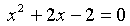
Solution: The quadratic formula gives

where a is a nonzero constant and b and c are arbitrary.
produces a parabola.
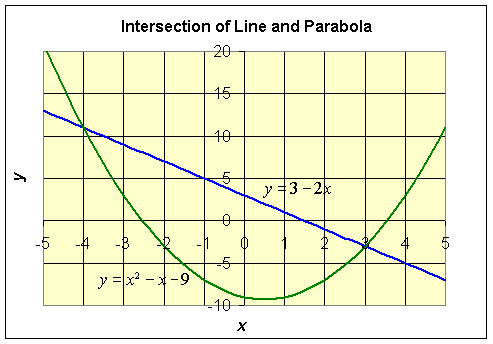
Example 5: Find the intersections of the line y = 3 - 2x and the quadratic function
Sketch a graph of these functions.
Solution:
so x = -4 or 3.
More Worked Examples are provided on a hyperlinked page.
[1] H. Bremer and P. P. Dennis, "Modulation of chemical composition and other parameters of the cell by growth rate," Escherichia coli and Salmonella typhimurium, ed. F. C. Neidhardt, American Society of Microbiology, Washington, D.C., 1987.