|

|
Math 121 - Calculus for Biology I
Spring Semester, 2004
Derivative of ex and ln(x)
|
|
|
|
© 2001, All Rights Reserved, SDSU
& Joseph M. Mahaffy
San Diego State University -- This page last updated 03-Jan-04
|
|
 The Derivative of ex and ln(x)
- Prozac
- Half-life of a Drug
- Norfluoxetine Kinetic Model
- Derivative of the Exponential
- Application of the Derivative to the
Prozac Kinetic Model
- Height vs Weight Relationship
- Derivative of ln(x)
- Worked Examples
- References
Prozac
- Fluoxetine, commonly known
by its trade name Prozac, is a selective
serotonin reuptake inhibitor (SSRI)
- This drug is used to treat depression, obsessive compulsive
disorder, and a number of other neurological disorders
- It works by preventing serotonin from being reabsorbed too
rapidly from the synapses between nerve cells, prolonging its availablity,
which improves the patient's mood
- Fluoxetine is metabolized in the liver and transformed into
a slightly less potent SSRI, norfluoxetine
- Both compounds bind to plasma protein, then become concentrated
in the brain (up to 50 times more concentrated)
- Fluoxetine and norfluoxetine are eliminated from the brain
with characteristic half-lives of 1-4 days and 7-15 days, respectively
- It is very important to understand the kinetics of the drug
in the body
- Drugs metabolized into another active form make modeling
more complex
- Models below examine first order kinetic models for the
concentrations of fluoxetine (F(t))
and norfluoxetine (N(t))
in the blood
Half-Life
of a Drug
- Half-life of a drug is similar to the half-life of radioactive
material
- A subject taking a 40 mg oral dose of fluoxetine rapidly
exhibits a blood stream concentration of 21 ng/ml
- One study of healthy volunteers showed the half-life of
fluoxetine was 1.5 days
- Assume instantaneous uptake of the drug, then the initial
blood concentration of fluoxetine is
F(0)
= 21 ng/ml.
- When a drug is either filtered out by the kidneys or metabolized
by some organ such as the liver proportional to its concentration, then the
drug is said to exhibit first-order kinetics
- The drug decays exponentially with a characteristic half-life
- Fluoxetine is metabolized in both the brain and liver, so
satisfies the kinetic equation
F(t)
= 21e-kt
- With a half-life of 1.5 days, we have
F(1.5)
= 10.5 = 21e-1.5k
- Solving this equation for k,
e1.5k
= 2
k =
ln(2)/1.5 = 0.462
- A good model for blood plasma concentration of fluoxetine
is
F(t)
= 21e-0.462t
Norfluoxetine
Kinetic Model
- Fluoxetine is metabolized in the liver and through a hepatic
biotransformation becomes norfluoxetine (through a demethylation)
- Norfluoxetine continues to act as potent and specific serotonin
reuptake inhibitor
- The half-life is taken to be 9 days for norfluoxetine
- A reasonable model using linear kinetics for the blood plasma
concentration of norfluoxetine is
N(t)
= 27.5(e-0.077t - e-0.462t).
- Below is a graph of the fluoxetine and norfluoxetine concentrations
from the models
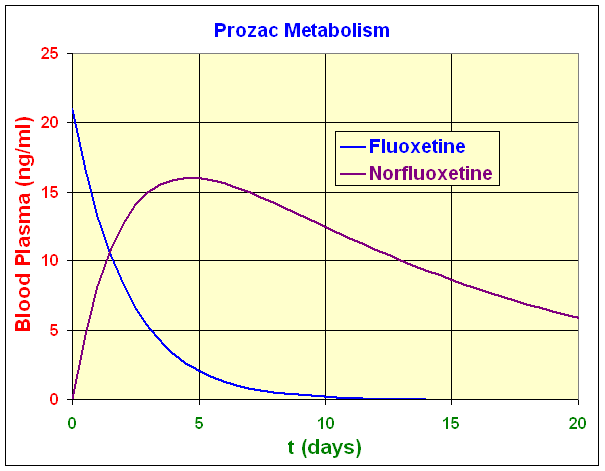
- Determine the rate of change of fluoxetine and norfluoxetine
- Find the time of maximum blood plasma concentration of
norfluoxetine and what that concentration is
- To solve these problems, we need to learn the formula for
the derivative of the exponential function.
Derivative
of ex
- The exponential function ex is a special
function
- It's the only function (up to a scalar multiple) that is
the derivative of itself
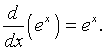
- From the definition of the derivative and using the properties
of exponentials
 .
.
- One definition of the number e
is the number that makes
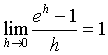
- Geometrically, the function ex is a number
raised to the power x, whose slope of the tangent line at x
= 0 is 1.
General rule for the derivative of ekx
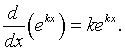
Example 1: Find
the derivative of
f(x) = 5 e-3x.
Solution:
From our rule of differentiation and the formula above, we have
f
'(x) = -15 e-3x.
Application of
the Derivative to the Prozac Kinetic Model
- Find the rate of change of fluoxetine and norfluoxetine
- The function modeling blood plasma concentration of fluoxetine
is
F(t)
= 21e-0.462t
F
'(t) = (-0.462)21e-0.462t = -9.702e-0.462t
- The model for the blood plasma concentration of norfluoxetine
is
N(t)
= 27.5e-0.077t - 27.5 e-0.462t
N
'(t) = (-0.077)27.5e-0.077t - (-0.462)27.5 e-0.462t
= 12.705e-0.462t - 2.1175 e-0.077t
- The rate of change of blood plasma concentration of fluoxetine
at times t
= 2 and 10 is
F
'(2) = -9.702e-0.462(2) =
-3.85 ng/ml/day
F
'(10) = -9.702e-0.462(10) =
-0.0956 ng/ml/day
- The rate of change of norfluoxetine blood plasma concentration
at times t
= 2 and 10 is
N
'(2) = 12.705e-0.462(2) - 2.1175 e-0.077(2). =
3.23 ng/ml/day
N
'(10) = 12.705e-0.462(10) - 2.1175 e-0.077(10). =
-0.855 ng/ml/day
- These calculations show that at t
= 2 the blood plasma concentration of fluoxetine is dropping quite
rapidly, while blood plasm concentration of norfluoxetine is rising at a similar
rate
- The calculations at t
= 10 show that the blood plasma concentration of both compounds
are falling at fairly slow rates
Maximum Concentration of
Norfluoxetine
- The maximum concentration of norfluoxetine is found by determining
when the derivative is equal to zero
N
'(t) = 12.705e-0.462t - 2.1175 e-0.077t =
0
2.1175 e-0.077t = 12.705e-0.462t
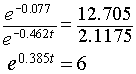
0.385t = ln(6)
tmax = 4.654
days
- The maximum blood plasma concentration of norfluoxetine
is
N(tmax)
=16.01 ng/ml
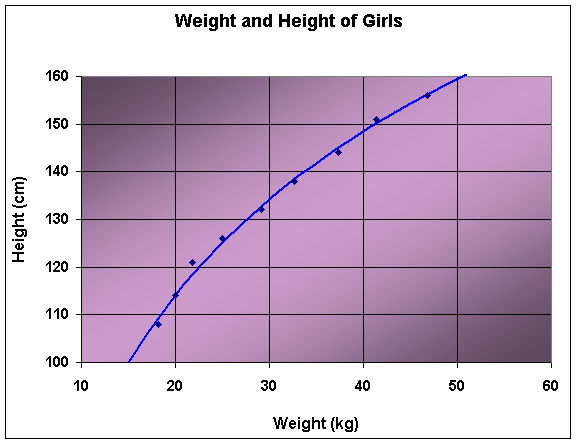
Height and Weight Relationship for Children
The average height and weight
of girls in the U. S.
|
age(years)
|
height(cm)
|
weight(kg)
|
|
5
|
108
|
18.2
|
|
6
|
114
|
20.0
|
|
7
|
121
|
21.8
|
|
8
|
126
|
25.0
|
|
9
|
132
|
29.1
|
|
10
|
138
|
32.7
|
|
11
|
144
|
37.3
|
|
12
|
151
|
41.4
|
|
13
|
156
|
46.8
|
-
Ehrenberg noted that there was a logarithmic
relationship between the height and the weight of children
-
The formula for the height, H,
as a function of weight, w, is given
by
H(w)
= 49.5ln(w) - 34.14.
Derivative
of ln(x)
- The derivative of the natural logarithm, ln(x), is given by the formula
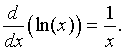
- This relationship is most easily demonstrated after learning
the Fundamental Theorem of Calculus in Math 122, which centers about the integral.
Derivative of the Height and
Weight Relationship for Children
- The relationship for height as a function of weight was
given by
H(w)
= 49.5ln(w) - 34.14
- This is easily differentiated with respect to w,
using the derivative for the natural logarithm

- From this relationship, it is clear that as the weight increases,
the rate of change in height decreases
-
For example, at a weight of 20
kg.
H
'(20) = 49.5/20 = 2.475 cm/kg
while at a weight of 49.5
kg
H
'(49.5) = 49.5/49.5 = 1 cm/kg
- Note that this is not the rate of change of the height as
a function of the age, which we saw to be nearly linear
Example 3: Find
the derivative of
f(x) = ln(x2).
Solution:
From our properties of logarithms and the formula above,
f(x) = ln(x2) = 2ln(x)
f
'(x) = 2/x.
Worked Examples