e. The growth rate of the Nonautonomous dynamical model goes to zero during this century for Version 1: France Version 2: Japan Version 3: Mexico. At this time, this model predicts that the population will reach its maximum and start declining. Use the growth rate k(t) to find when this model predicts a maximum population, then estimate what that maximum population will be.
Solutions:
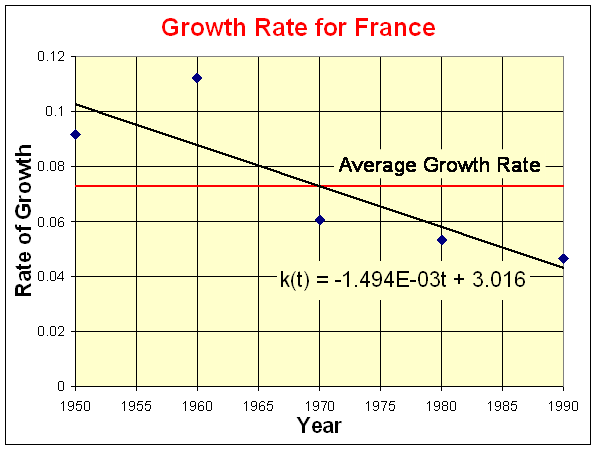
Version 1: a. The table below shows the growth rate per decade for France. The average growth rate for France is given by r = 0.07287, and the best straight line growth rate from the data is given by the formula
k(t) = 3.016 - 0.001494 t.
| Year |
1950
|
1960
|
1970
|
1980
|
1990
|
| Growth Rate |
0.09180
|
0.1121
|
0.06064
|
0.05328
|
0.04653
|
Below is a graph of the growth rate for each decade, which includes the trendline from Excel, the data, and a horizontal line for the average growth rate.
b. The general solution to the discrete Malthusian growth model for France with the average growth rate is given by
Pn = (1.07287)n41.83.
This model predicts that the population will be P7 = 68.44 million in 2020 and P10 = 84.52 million in 2050.
c. The nonautonomous discrete dynamical system, which simulates the growth of France's population, is given by
Pn+1 = (4.016 - 0.001494 tn)Pn,
where tn = 1950 + 10n. This model predicts that the population will be P7 = 61.85 million in 2020 and P10 = 58.77 million in 2050.
d. Below is a table giving the population (in millions) data, the Malthusian growth model (along with its percent error), and the modified Malthusian growth model (along with its error).
|
Year
|
Population
|
Malthusian Model
|
% Error
|
Modified Model
|
% Error
|
|
1950
|
41.83
|
41.83
|
0
|
41.83
|
0
|
|
1960
|
45.67
|
44.88
|
-1.73
|
46.13
|
0.998
|
|
1970
|
50.79
|
48.15
|
-5.20
|
50.17
|
-1.21
|
|
1980
|
53.87
|
51.66
|
-4.11
|
53.83
|
-0.079
|
|
1990
|
56.74
|
55.42
|
-2.32
|
56.94
|
0.36
|
|
2000
|
59.38
|
59.46
|
0.13
|
59.39
|
0.014
|
The maximum error for the discrete Malthusian growth model occurs in 1970 with the predicted value being 5.2% too low, while the modified Malthusian growth model has a maximum error of -1.21%, also in 1970. Below is a graph of the data and the solutions to the models in Parts b. and c.
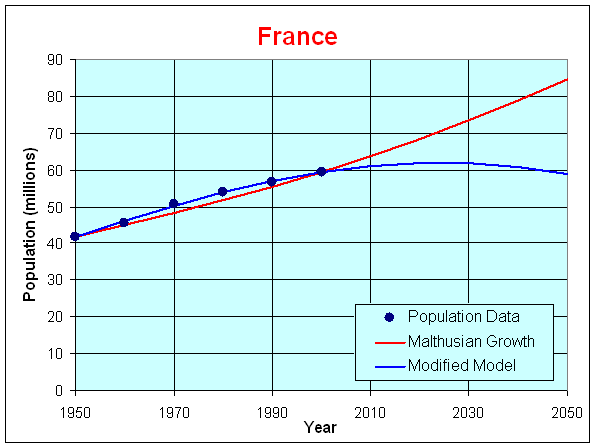
From the error analysis, the nonautonomous Malthusian growth model is better at predicting the actual population and shows only a very small error. Both models predict the population reasonably well since the time interval is fairly short, but as seen in the graph, the nonautonomous Malthusian growth model does extremely well. The main strength of the discrete Malthusian growth model is its simplicity. However, the minor modification of a linear growth rate in the nonautonomous Malthusian growth model substantially increases the accuracy of the model without making the model much more complicated. Both models match the population data fairly well. Their simplicity is also a weakness as it doesn't give one confidence that the model can predict too far into the future. These models give no information about how population is divided into age groups or other important demographic information. There are any number of more complicated models, especially using statistical techniques, that will provide better future predictions.
e. The growth rate, k(t), is zero when t = 2018.7. Thus, the nonautonomous Malthusian growth model for France predicts that France will achieve its maximum population late in the year 2018. From the simulation, we see that this maximum population should be approximately 61.85 million (the predicted population for 2020).
Version 2: a. The average growth rate for India is given by r = 0.1545, but India's growth rate is actually increasing (opposite the trend in the U.S.). Below is a graph of the growth rate for each decade, which includes the trendline from Excel, the data, and a horizontal line for the average growth rate.
b. Below is a table showing the simulation of the discrete Malthusian growth model for India with the average growth rate r = 0.1545.
|
|
|
|
|
|
|
|
|
|
|
|
|
|
|
|
|
|
|
|
|
|
|
|
|
|
|
|
|
|
|
|
|
|
|
c. Below is a table with the values for the nonautonomous discrete dynamical system, which simulates the growth of India's population.
|
|
|
|
|
|
|
|
|
|
|
|
|
|
|
|
|
|
|
|
|
|
|
|
|
|
2001 |
|
|
|
|
|
|
|
|
d. Below is a graph of the data and the solutions to the models in Parts b. and c.
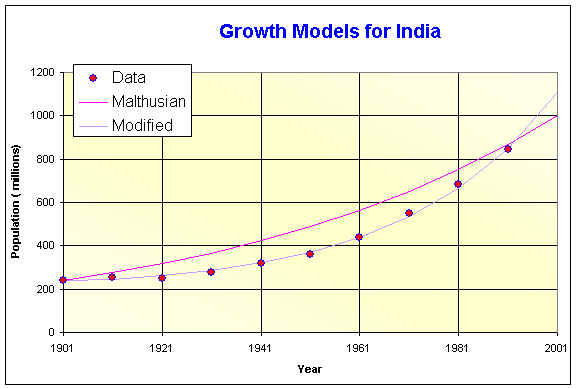
The graph shows the Modified model very closely approximating the population, while the Malthusian growth model fails to predict well through the intermediate range. This is because India's population is accelerating as seen from the growth data in Part a., so the mean population growth poorly represents population trends as we saw in the U.S. population models. The strength in these models is their relatively accurate match to the data, yet they are fairly simple, especially the Modified model. The simplicity of the Malthusian growth model shows its weakness, as fails to match the data in the intermediate range. The Modified growth model should be reasonable for predicting India's growth over the short term, but clearly India cannot keep accelerating its population growth. There are any number of more complicated models, especially using statistical techniques, that will provide better future predictions.
e. Below is a table with the percent errors for the dates 1921, 1961, and 1981 between the data and the Malthusian growth model and the improved nonautonomous growth model. The Improved model shows excellent agreement to the actual data at these dates, while the Malthusian Growth model fails, especially at the intermediate dates.
|
|
|
|
|
|
|
|
|
|
|
|
|
|
|
|
|
|
|
|
|
|
|
|
|
|
|
|
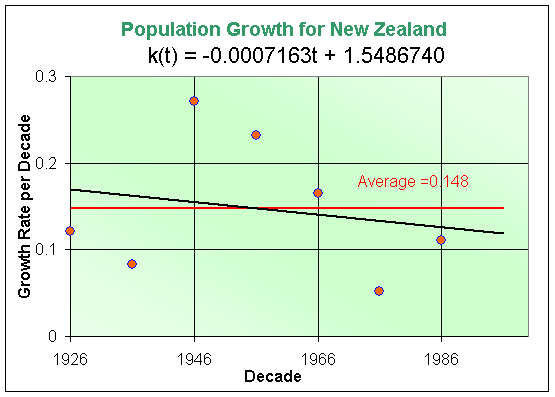
Version 3: a. The average growth rate for New Zealand is given by r = 0.148. Below is a graph of the growth rate for each decade, which includes the trendline from Excel, the data, and a horizontal line for the average growth rate.
b. Below is a table showing the simulation of the discrete Malthusian growth model for New Zealand with the average growth rate r = 0.148.
|
|
|
|
|
|
|
|
|
|
|
|
|
|
|
|
|
|
|
|
|
|
|
|
|
|
2006 |
|
c. Below is a table with the values for the nonautonomous discrete dynamical system, which simulates the growth of New Zealand's population.
|
|
|
|
|
|
|
|
|
|
|
|
|
|
|
|
|
|
|
|
|
|
|
|
|
|
2006 |
|
d. Below is a graph of the data and the solutions to the models in Parts b. and c.
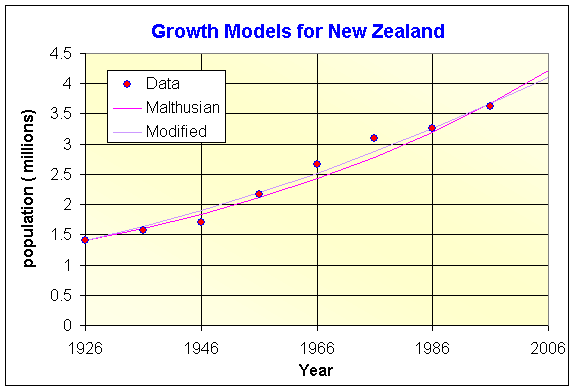
The graph of the two models agree fairly closely through the range of the data, yet show a divergence for future predictions. The extreme fluctuating data in Part a. indicates that neither model will be overly reliable as neither the mean nor a straight line fit through the data should be a good representation. Since the growth data in Part a. showed an almost random pattern about the mean and the trendline was almost flat, one would expect the two models to agree fairly closely, as they do, but the data remains scattered about the models. The strength in these models is their relatively accurate match to the data for their simplicity. Their simplicity is also a weakness as it doesn't give one confidence that the model can predict too far into the future. There are any number of more complicated models, especially using statistical techniques, that will provide better future predictions.
e. Below is a table with the percent errors for the dates 1936, 1966, and 1986 between the data and the Malthusian growth model and the improved nonautonomous growth model. Both the Malthusian and Improved models show excellent agreement to the actual data at these dates.
|
|
|
|
|
|
|
|
|
|
|
|
|
|
|
|
|
|
|
|
|
|
|
|
|
|
|
|